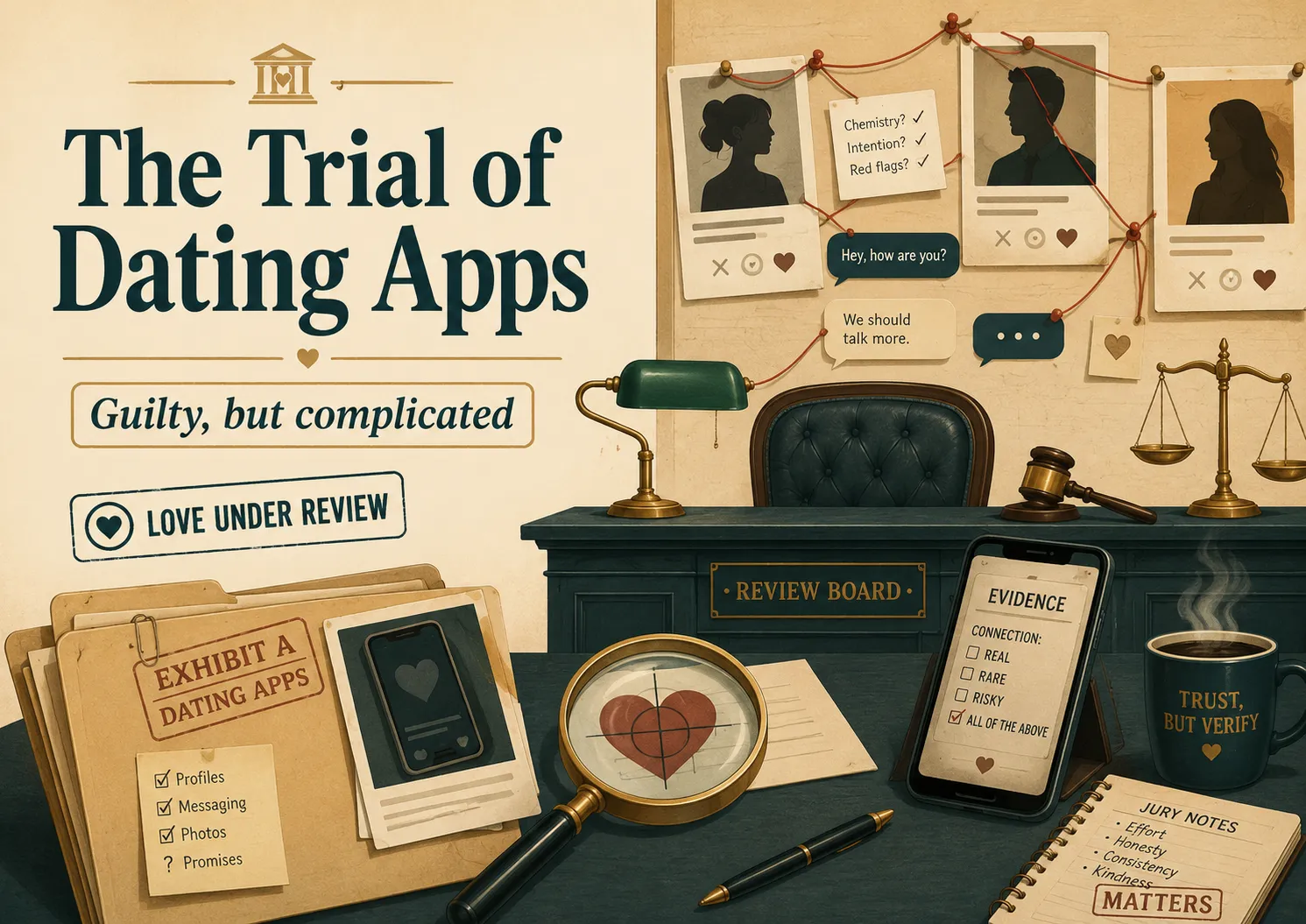
Dating apps stand accused of making people feel replaceable, turning connection into a catalog, and giving modern romance the emotional stability of a loading screen. But are they truly guilty, or are they just exposing what humans were already doing badly?
The Accused
Dating apps now stand before the Review Board accused of crimes against modern romance, emotional stamina, and the sacred human right to not be judged entirely by six photos and a bio written during a moment of false confidence.
The accused appears in court wearing a clean interface, a suspiciously optimistic slogan, and the energy of something that says, “We help people connect,” while quietly handing everyone a thousand more reasons to overthink.
Dating apps are not new villains. People were confusing each other long before the swipe was invented. But the court must consider whether these apps made the confusion faster, shinier, and somehow more exhausting.
Charges Filed
The court recognizes the following charges:
- Turning people into profiles.
- Encouraging everyone to believe a better option may be one swipe away.
- Making rejection feel casual, constant, and strangely normal.
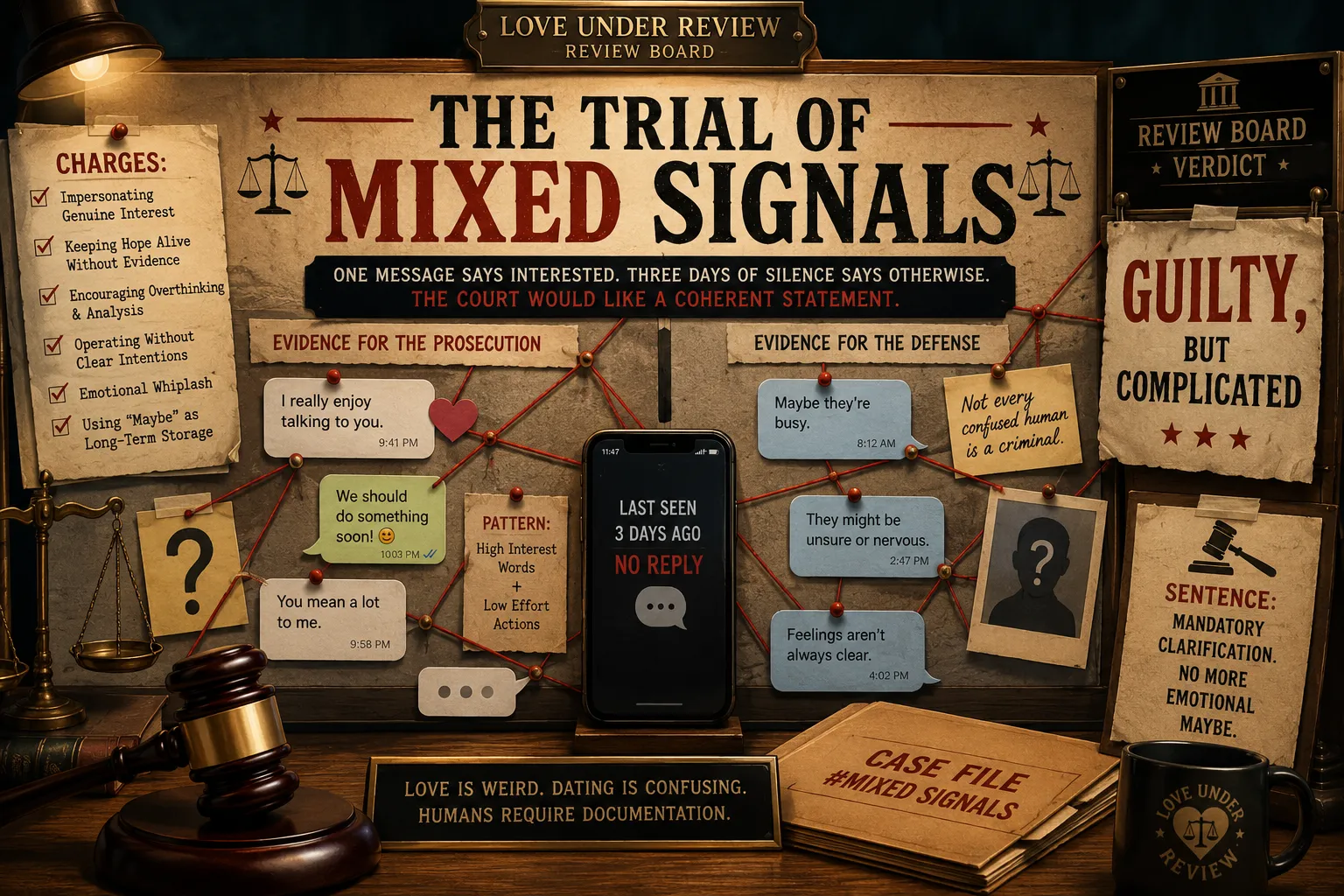
- Creating conversations that begin with potential and die after “lol.”
- Making people say they are “just seeing what’s out there,” which is legally suspicious.
- Giving modern dating the emotional stability of a loading screen.
The accused has entered a plea of: complicated.
Opening Statement
Ladies, gentlemen, and emotionally tired singles of the jury, dating apps promised access.
And to be fair, they delivered.
They gave people a way to meet outside work, school, friend groups, church, grocery stores, and the fantasy version of real life where someone attractive reaches for the same avocado at the exact same time.
But access is not the same thing as connection.
That is where the case gets messy.
Because dating apps did not invent the fear of rejection. They did not invent mixed signals. They did not invent people who say they want something serious while behaving like they are allergic to clarity.
But they did give all of that behavior a convenient place to gather.
Evidence for the Prosecution
The prosecution would like to submit Exhibit A: the endless scroll.
There is something psychologically strange about looking for human connection in a format that feels almost exactly like shopping. A person becomes a photo, a sentence, a height, a hobby, a joke, a job title, and maybe a dog they borrowed for emotional credibility.
Then comes the swipe.
Yes. No. Maybe. Absolutely not. Why is everyone holding a fish?
This does not always bring out the best in people.
Dating apps can make it feel like every person is competing against an invisible crowd. Even when a conversation is going well, there is the quiet awareness that both people may still be browsing. That can make connection feel temporary before it even begins.
The prosecution also submits Exhibit B: the low-effort opener.
“Hey.”
A powerful word. A historic word. A word that says, “I have technically begun this conversation, but I will not be providing emotional labor at this time.”
Some conversations feel less like two people meeting and more like two exhausted employees attending a mandatory team-building exercise.
Then there is ghosting. The talking stage. The almost-date. The match that seemed promising until one person disappeared like they were recalled by corporate.
Dating apps did not invent avoidance, but they did make avoidance extremely convenient.
Evidence for the Defense
The defense rises.
And honestly, the defense has a point.
Dating apps are not pure evil. For many people, they are practical. Adults are busy. Social circles get smaller. Work takes energy. Parenting takes energy. Existing takes energy. Not everyone has a charming local coffee shop where emotionally available strangers wait near the muffins.
Dating apps can help people meet someone they never would have found otherwise.
They can help shy people start conversations. They can help people in small towns expand their options. They can help single parents, introverts, and busy adults re-enter the dating world without needing to randomly appear at social events like a side character in a romantic comedy.
The app is not always the problem.
Sometimes the problem is that humans are using a connection tool while carrying fear, boredom, unrealistic expectations, bad communication habits, unresolved baggage, and a profile that says “no drama,” which usually means drama has already been briefed by legal counsel.
Witness Testimony
A single person approaches the stand.
They swear to tell the truth, the whole truth, and nothing but the emotionally inconvenient truth.
Their testimony is as follows:
“I do not hate dating apps. I hate the way they make hope feel repetitive. You download the app, set up the profile, try to sound interesting but not desperate, funny but not weird, honest but not too honest, confident but not arrogant. Then you swipe. Then you match. Then you talk. Then it either becomes something, becomes nothing, or becomes a screenshot you send to a friend with the caption, ‘What does this even mean?’”
The court accepts this testimony as painfully credible.
Cross-Examination
The prosecution asks:
“Do dating apps make people feel replaceable?”
Answer: Often, yes.
The defense asks:
“Would many people meet fewer potential partners without them?”
Answer: Also yes.
The prosecution asks:
“Do dating apps reward quick judgment?”
Answer: Absolutely.
The defense asks:
“Is quick judgment sometimes just how attraction starts?”
Answer: Unfortunately, also yes.
The prosecution asks:
“Are dating apps guilty of ruining dating?”
The court pauses here.
Because dating was already weird.
Before apps, people were still misreading signals, avoiding honest conversations, choosing emotionally unavailable people, staying too long, leaving too soon, and asking their friends to decode a sentence that probably meant exactly what it said.
Dating apps may not have ruined dating.
They may have simply turned the lights on in a room that was already messy.
Final Verdict
The Review Board finds dating apps guilty, but complicated.
Guilty of making people feel replaceable.
Guilty of encouraging endless comparison.
Guilty of making connection feel like a numbers game with bad customer service.
But not guilty of inventing human confusion.
Dating apps are not the whole disease. They are more like the thermometer, the waiting room, and occasionally the person coughing directly into the emotional air conditioning.
They reveal something uncomfortable about modern dating: people want connection, but they also want options. They want honesty, but not always vulnerability. They want chemistry, but not awkwardness. They want effort, but not pressure.
That contradiction did not come from an app.
The app just gave it notifications.
Sentence
Dating apps are hereby sentenced to 90 days of supervised emotional rehabilitation.
They must add a warning label that reads:
“May cause optimism, confusion, mild despair, unexpected confidence, sudden deletion, and the belief that everyone within 25 miles is either hiking, holding a fish, or ‘not on here much.’”
They may remain in use, but only with caution.
The court recommends limited exposure, realistic expectations, and remembering that behind every profile is either a human being, a red flag, or someone who really needs to retake their bathroom mirror photo.
Case closed.
For now.