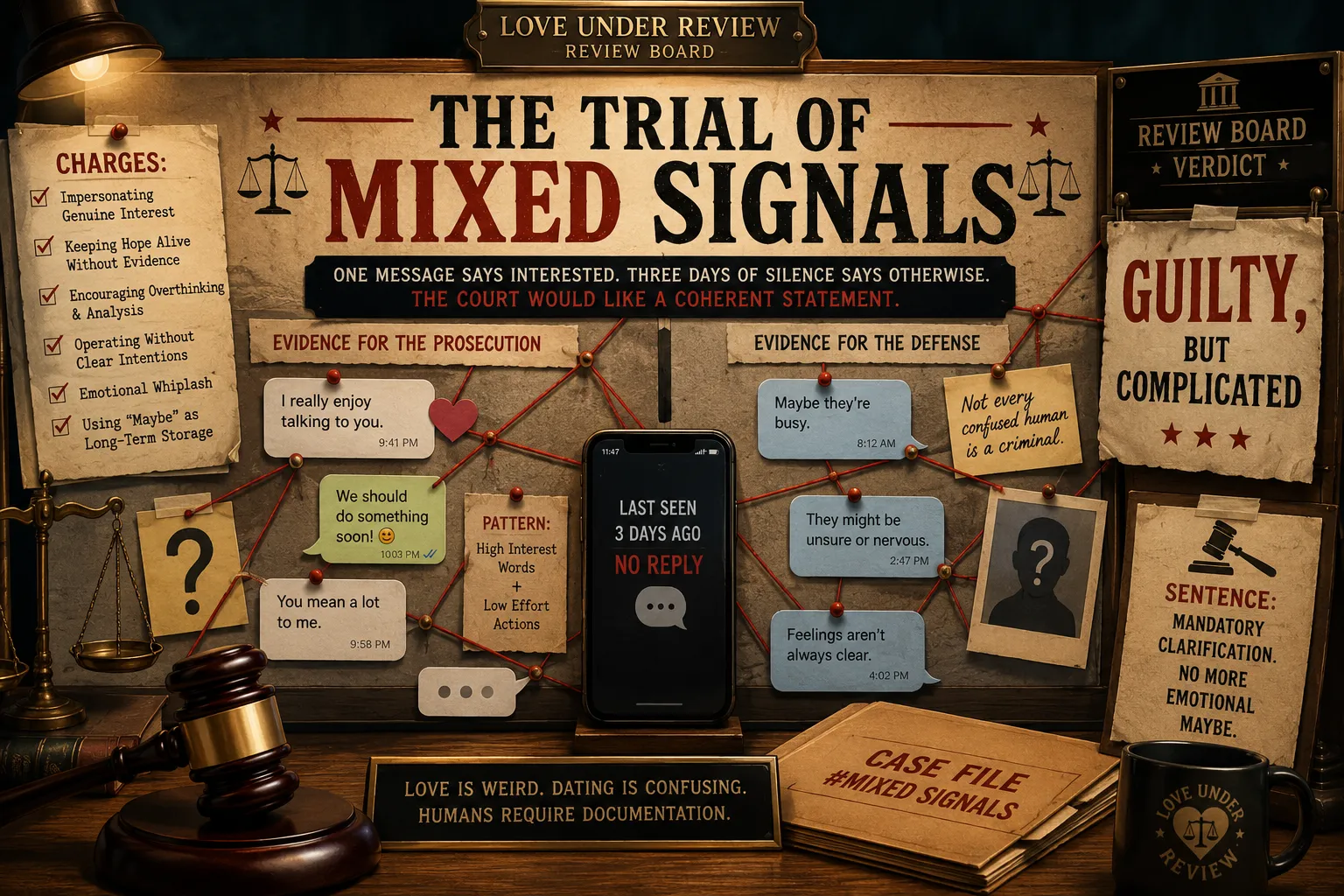
Mixed signals stand accused of impersonating genuine interest, encouraging unnecessary detective work, and keeping hope alive without sufficient evidence. But are they always manipulation, or are confused humans simply terrible at communicating uncertainty?
The Accused
Mixed signals now stand before the Review Board accused of creating confusion, encouraging reckless overthinking, and keeping hope alive without sufficient evidence.
The accused arrived late, made strong eye contact, said, “We should definitely do something soon,” and then disappeared for four business days.
The court has already begun taking notes.
Mixed signals are difficult to define because they rarely appear as one obvious act. They are usually assembled from several smaller pieces:
A warm message.
A delayed reply.
A compliment.
A canceled plan.
An affectionate conversation.
A sudden emotional evacuation.
Individually, these events may mean nothing. Together, they create the relationship equivalent of a flashing dashboard light that no mechanic can explain.
The question before the court is simple:
Are mixed signals an unavoidable side effect of human uncertainty, or are they guilty of keeping people emotionally attached without offering them anything clear to hold onto?
Charges Filed
The prosecution files the following charges:
- Impersonating genuine romantic interest.
- Keeping hope alive without supporting documentation.
- Encouraging civilians to analyze message timing, punctuation, and emoji selection.
- Making ordinary inconsistency appear mysterious and emotionally important.
- Requiring one person to interpret what another person refuses to communicate.
- Using “maybe” as long-term emotional storage.
- Causing otherwise reasonable adults to ask their friends, “What do you think this means?”
- Breadcrumbing: distributing just enough attention to keep someone following a path that never reaches an actual destination.
The accused enters a plea of:
“It is complicated.”
The court notes that this is exactly the sort of answer that led to the trial.
Opening Statement
Members of the jury, mixed signals survive because clarity requires risk.
Saying “I like you” creates the possibility of rejection.
Saying “I do not want this” creates the possibility of hurting someone.
Saying “I am interested, but I am not ready” requires self-awareness, honesty, and several complete sentences.
It is often easier to remain vague.
Vagueness allows a person to keep the connection without defining it. They can enjoy attention without accepting responsibility for the expectations their behavior creates.
But the defense will argue that humans are not machines with perfectly updated emotional software.
People become confused.
They get scared.
They change their minds.
They retreat when something begins to feel real.
They may send mixed signals because they are receiving mixed signals from themselves.
The court accepts that feelings can be complicated.
The court does not accept that complicated feelings grant unlimited permission to confuse everyone nearby.
Evidence for the Prosecution
The prosecution submits Exhibit A: enthusiastic words unsupported by consistent behavior.
“I really enjoy talking to you.”
“We should go out again.”
“I have been thinking about you.”
These statements sound promising. They are normally understood as evidence of interest.
Then nothing happens.
No plan is made. No conversation develops. No explanation arrives. The person remains emotionally present enough to preserve hope but practically absent enough to avoid commitment.
This is where mixed signals become dangerous.
A clear rejection hurts, but it gives someone information. Mixed signals provide just enough encouragement to delay acceptance.
The person receiving them begins collecting evidence.
They replied quickly on Tuesday.
They used a heart on Thursday.
They disappeared Friday.
They watched the story Saturday.
They returned Sunday with “Sorry, things have been crazy.”
By Monday, the investigation has expanded into a full federal operation.
The prosecution submits Exhibit B: selective availability.
The accused is available when lonely, bored, curious, nostalgic, or in need of reassurance.
However, the accused becomes unavailable whenever consistency, planning, emotional honesty, or accountability enters the room.
This creates a connection that feels real during certain moments but becomes impossible to locate whenever someone asks what it is.
The prosecution calls this emotional inconvenience.
The defense may call it uncertainty.
The person receiving it usually calls a friend.
The prosecution submits Exhibit C: breadcrumbing.
Breadcrumbing occurs when someone provides small, irregular pieces of attention that keep a connection alive without allowing it to become clear or consistent.
A message arrives just as interest begins to fade.
A compliment appears after several days of silence.
A vague future plan is mentioned but never scheduled.
Nothing is substantial enough to build a relationship from, but each small gesture is persuasive enough to delay walking away.
This pattern creates a cycle of inconsistency and confusion. The person receiving the signals is never given enough evidence to feel secure, but they are repeatedly given just enough evidence to question whether leaving would be premature.
The court recognizes that not every breadcrumb is deliberately placed.
However, accidental confusion experienced repeatedly begins to resemble a pattern, regardless of the original intent.
Evidence for the Defense
The defense rises and asks the court to recognize an uncomfortable fact:
Sometimes people genuinely do not know what they want.
Attraction is not always immediate or stable. A person can enjoy someone’s company while remaining uncertain about romantic compatibility. They can feel interest and fear simultaneously. They can want connection while realizing they are not prepared for what connection requires.
Not every delayed reply is a strategy.
Not every canceled plan is rejection.
Not every shift in tone is evidence of emotional fraud.
People have jobs, children, responsibilities, stress, grief, exhaustion, and private problems that do not appear in a text conversation.
The defense also reminds the court that signals are interpreted, not merely transmitted.
One person may think they are being friendly.
Another may interpret that friendliness as flirting.
One person may believe, “I am still deciding.”
The other may believe, “We are slowly building something.”
No one has technically lied, but two completely different stories are being written in the same conversation.
The defense therefore argues that mixed signals are sometimes less like manipulation and more like a translation error between two nervous human beings.
The court finds this argument annoyingly reasonable.
Witness Testimony
A confused individual approaches the stand carrying screenshots, timestamps, and the exhausted expression of someone who has asked, “Am I overthinking this?” more than once.
The witness testifies:
“The hardest part was not that the person might not want me. I could have handled that. The hardest part was that every time I started accepting they were not interested, they did something that made me question the conclusion.”
The prosecution asks what kind of things.
The witness responds:
“They would disappear, then come back affectionate. They would avoid making plans, then tell me they missed me. They would act interested when we were together and uncertain when we were apart.”
The court asks whether the witness ever requested clarification.
The witness looks toward the floor.
“Not directly.”
A silence enters the courtroom.
This evidence complicates the case.
Mixed signals often require two participants: one person avoiding clarity and another person hoping the evidence will eventually become clearer without requiring an uncomfortable conversation.
The court does not assign equal responsibility.
But it does take judicial notice of the fact that humans sometimes prefer analyzing uncertainty over requesting an answer they may not like.
The testimony entered into the record can be summarized in three words:
Breadcrumbing.
Inconsistency.
Confusion.
The first preserves hope.
The second destroys trust.
The third keeps the entire case open longer than it should have remained under investigation.
Cross-Examination
The prosecution asks:
“Do mixed signals create false hope?”
Yes.
The defense asks:
“Can hope exist even when no promise was made?”
Also yes.
The prosecution asks:
“Should interested people make a reasonable effort to communicate their interest?”
Yes.
The defense asks:
“Can someone be interested and still emotionally unprepared?”
Unfortunately, yes.
The prosecution asks:
“If someone repeatedly acts interested and then disappears, is that confusing?”
Very.
The defense asks:
“Could the pattern reflect fear rather than cruelty?”
It could.
The prosecution asks:
“Does fear excuse leaving someone else indefinitely confused?”
No.
The defense rests.
The prosecution quietly circles that last answer.
Additional Evidence: The Difference Between Uncertainty and Convenience
The court must distinguish genuine uncertainty from convenient ambiguity.
Genuine uncertainty sounds like:
“I like you, but I am still trying to understand what I am ready for.”
Convenient ambiguity sounds like:
“Let us not put labels on anything,” followed by behavior that becomes suspiciously relationship-like whenever companionship is desired.
Genuine uncertainty includes honesty.
Convenient ambiguity includes access without accountability.
Genuine uncertainty may still be painful, but it gives the other person enough information to make a decision.
Convenient ambiguity keeps the decision permanently delayed.
That distinction matters.
A confused person can still communicate that they are confused.
Silence, inconsistency, and occasional affection are not a communication strategy. They are a scavenger hunt.
Final Verdict
The Review Board finds mixed signals guilty, but complicated.
They are guilty of forcing people to interpret behavior that should have been explained in words.
They are guilty of turning ordinary communication into an evidence-analysis department.
They are guilty of keeping connections alive long after clarity should have been requested or provided.
They are also guilty of using inconsistency as a delivery system and confusion as plausible deniability.
A breadcrumb may appear harmless by itself. But a trail of breadcrumbs leading nowhere is still a direction.
However, mixed signals are not always proof of calculated manipulation.
Sometimes they are evidence of fear.
Sometimes they are evidence of uncertainty.
Sometimes they are evidence that a person likes the connection but cannot offer the relationship the other person hopes it will become.
And sometimes they are not mixed at all.
Sometimes the signal is consistent, but it is not the signal someone wanted to accept.
Interest without effort is information.
Affection without consistency is information.
Repeated uncertainty is information.
The absence of clarity eventually becomes its own kind of answer.
Sentence
Mixed signals are hereby sentenced to mandatory clarification.
The accused must provide a plain-language statement of intent within one honest conversation.
Acceptable statements include:
“I am interested.”
“I am not interested.”
“I am interested, but I am not ready.”
“I do not know what I want, and I understand that you may not want to wait while I figure it out.”
Unacceptable statements include:
“Let us just see what happens.”
“I have been really busy.”
“I am bad at texting.”
“We should definitely hang out sometime.”
And the especially dangerous:
“I do not want a relationship, but I also do not want to lose what we have.”
Any signal that remains unclear after a reasonable request for clarification will be reclassified as insufficient evidence.
The court further advises the public that consistency is generally more reliable than chemistry experienced during isolated moments.
Mixed signals may remain legally complicated.
But no one is required to build a future from evidence that never becomes clear.
Case closed.
Pending further communication.