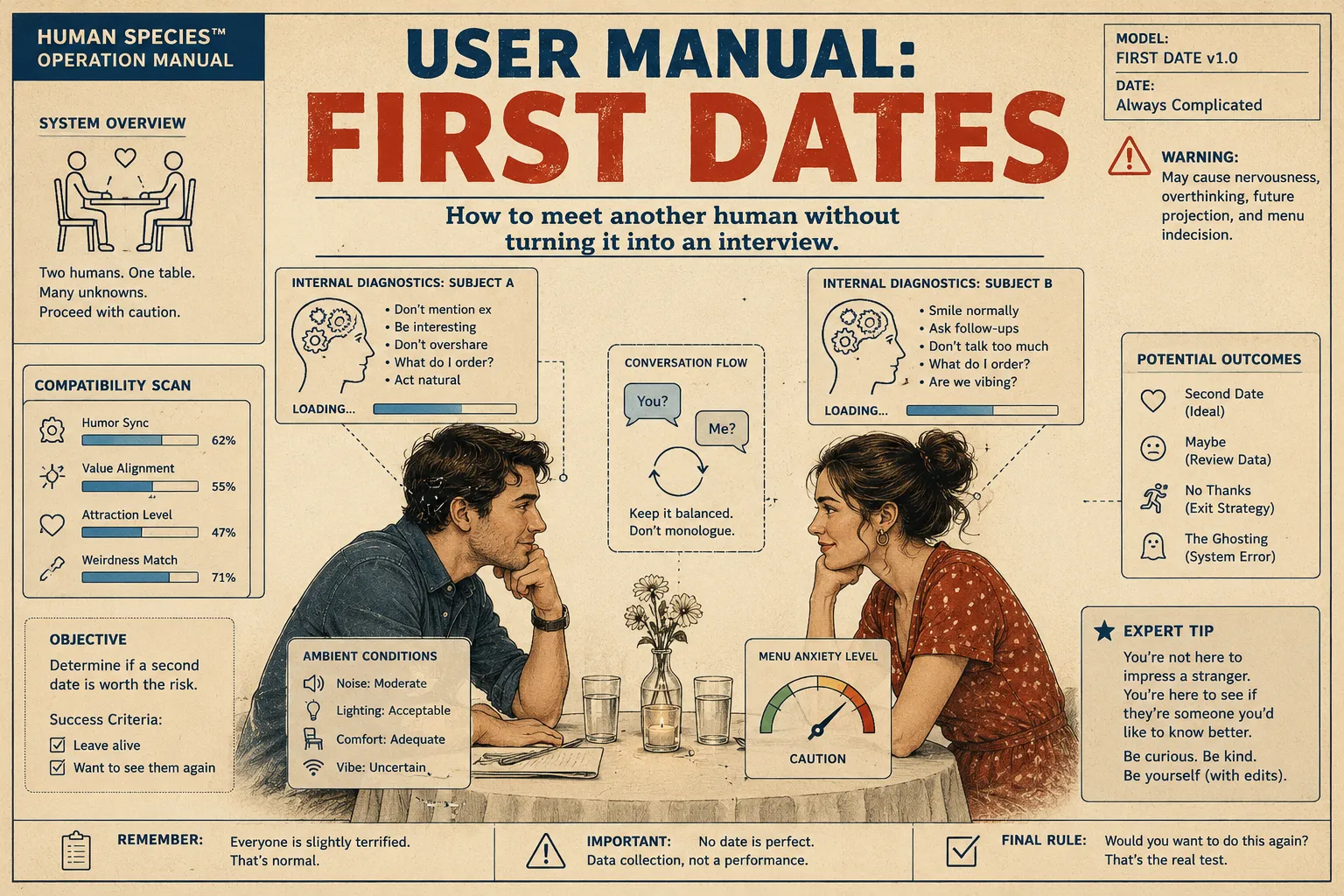
Self-awareness is useful, but modern relationship advice can make every failed connection feel like evidence against you. I am willing to consider that I may be the problem. I would simply like the investigation to remain open.
Opening Observation
I am willing to consider that I may be the problem.
I just think the Review Board should examine additional evidence before issuing a permanent ruling.
This does not seem unreasonable.
Personal accountability is important. Self-awareness is useful. Growth is generally considered good, although it has terrible marketing and often requires admitting things I would prefer to classify as clerical errors.
Still, there is a strange habit in modern relationship culture where every disappointing outcome becomes an invitation to investigate yourself.
The conversation faded?
Review your communication style.
The date went nowhere?
Review your emotional availability.
Someone gave mixed signals and disappeared?
Apparently, this is an excellent opportunity to reflect on why you keep attracting unavailable people.
At some point, you begin to wonder whether you are participating in dating or serving as the primary suspect in an investigation you accidentally opened against yourself.
The Situation
Whenever something fails, people offer the same respectable advice:
“Look at your patterns.”
“Work on yourself.”
“Ask what you contributed.”
“Take accountability.”
All of that sounds reasonable because it is reasonable.
The problem is what happens after you take it home.
A normal amount of reflection becomes a full internal audit.
Was I too quiet?
Did I seem uninterested?
Was I too interested?
Did I reply too quickly?
Did I wait too long?
Did I ask enough questions?
Did I ask so many questions that I became an unpaid podcast host?
Was I confident?
Was I trying so hard to appear confident that I accidentally looked like someone demonstrating confidence for a training video?
The investigation expands.
Soon, you are reviewing statements nobody objected to, facial expressions nobody mentioned, and messages that probably did not require forensic reconstruction.
Meanwhile, the other person may have simply decided the connection was not right.
Or they were not ready.
Or they were distracted.
Or they wanted something different.
Or they encountered a minor inconvenience and returned to the dating app to order another human.
There are many possible causes.
But self-aware people often nominate themselves first.
Why This Is Weird
The weird part is that accountability and compatibility are not the same thing.
A relationship can fail without either person being defective.
Two decent people can want different things. Two emotionally healthy people can lack chemistry. Two kind people can meet at the wrong time. Two people can communicate clearly and discover that the clear answer is no.
That is disappointing, but it is not necessarily evidence of personal failure.
Modern relationship language sometimes makes every outcome sound diagnosable.
If someone pulls away, one person must be avoidant.
If someone worries, they must be anxious.
If the conversation becomes awkward, somebody lacks emotional intelligence.
If the relationship ends, somebody ignored a pattern, failed to heal, chose from a wound, or attracted a lesson wearing attractive shoes.
Sometimes those explanations are accurate.
Sometimes two people just did not work.
The Review Board recognizes that “nothing is deeply wrong here” is not a very exciting conclusion.
It may still be the correct one.
My Current Theory
My current theory is that self-awareness becomes dangerous when it turns into self-prosecution.
There is a difference between asking, “What can I learn from this?” and asking, “What is wrong with me?”
The first question leaves room for information.
The second question has already reached a verdict.
That distinction matters because people who care about doing better are often the easiest people to convince that they are responsible for everything.
They replay conversations.
They inspect their motives.
They search for the lesson.
They wonder what a more confident, attractive, emotionally advanced version of themselves would have done differently.
Eventually, growth stops looking like improvement and starts looking like an endless entry requirement for being loved.
Maybe I need to communicate better.
Maybe I need more confidence.
Maybe I need to become more comfortable starting conversations.
Maybe I need to recognize when I am overthinking instead of connecting.
Those are legitimate areas for review.
But I also reject the idea that I must become a perfectly optimized human before I qualify for affection.
That product has not been released.
The entire species remains in beta.
The Case Against Me
In the interest of fairness, there is evidence for the prosecution.
I can overthink.
I may spend too much time trying to understand what something means instead of asking directly.
I sometimes assume people have already decided against me before enough evidence exists to support that conclusion.
That can make it harder to approach someone naturally. It is difficult to begin a conversation when part of your brain is already preparing the rejection report.
I may also expect people to notice qualities they have not yet had the opportunity to see.
Being caring, loyal, attentive, or capable of commitment does not automatically help during the first thirty seconds of an interaction.
Those qualities matter later.
First, someone has to become curious enough to stay.
That early stage requires skills that do not always resemble the skills needed to maintain a relationship. Starting a connection and sustaining one are related departments, but apparently they do not share the same hiring standards.
So yes, I may be part of the problem.
I may need to improve how I begin.
I may need to risk looking awkward instead of waiting to feel completely confident.
I may need to stop treating every uncertain interaction like a verdict on my overall value.
The prosecution has made several fair points.
Evidence for the Defense
The defense would like the record to show that difficulty finding the right connection is not proof that someone would be bad inside one.
It is possible to struggle with dating while still having strong relationship qualities.
It is possible to be awkward at introductions and dependable after trust develops.
It is possible to be uncertain while flirting and clear when commitment matters.
It is possible to lack confidence without lacking value.
The earliest stages of dating reward visibility, timing, charm, and social ease.
Long-term relationships depend more heavily on consistency, honesty, patience, affection, communication, and the ability to stay present when things stop being exciting.
Those are not identical skill sets.
A person can perform beautifully during the interview and become terrible after onboarding.
Another person can stumble through the interview and become the most reliable member of the department.
Unfortunately, humans frequently make permanent decisions using preliminary data.
This is why the Review Board recommends caution before labeling anyone—including yourself—as the problem.
Where I Might Be Wrong
There is always the possibility that “I need more evidence” is just a sophisticated way to delay accepting evidence I do not like.
That has been entered into the record.
Sometimes patterns really are patterns.
If the same problem follows you through multiple relationships, dates, friendships, and conversations, eventually it becomes difficult to blame the lighting.
Sometimes self-compassion becomes self-exemption.
Sometimes saying “the right person will understand me” means refusing to communicate more clearly.
Sometimes saying “I am just being myself” means treating personal growth like an unreasonable customer complaint.
That is why the investigation should remain open.
Not because I deserve endless blame.
Because I deserve accurate information.
The goal is not to prove that I am innocent.
The goal is to understand what is actually mine to improve—and what was never mine to carry.
Final Lab Note
I may be the problem.
I may be part of the problem.
I may occasionally be a small contributing factor wearing the confidence of a central cause.
But one failed conversation, one rejection, or one relationship ending does not establish a complete psychological profile.
Some experiences reveal where we need to grow.
Some reveal what we should no longer tolerate.
Some reveal nothing more dramatic than incompatibility, poor timing, or two people who could not build the same future.
Self-awareness should help us become more honest.
It should not train us to assume that every closed door is a character reference.
So the Review Board will continue examining the evidence.
Accountability remains encouraged.
Unnecessary self-prosecution has been suspended pending further review.
Official verdict: context required.