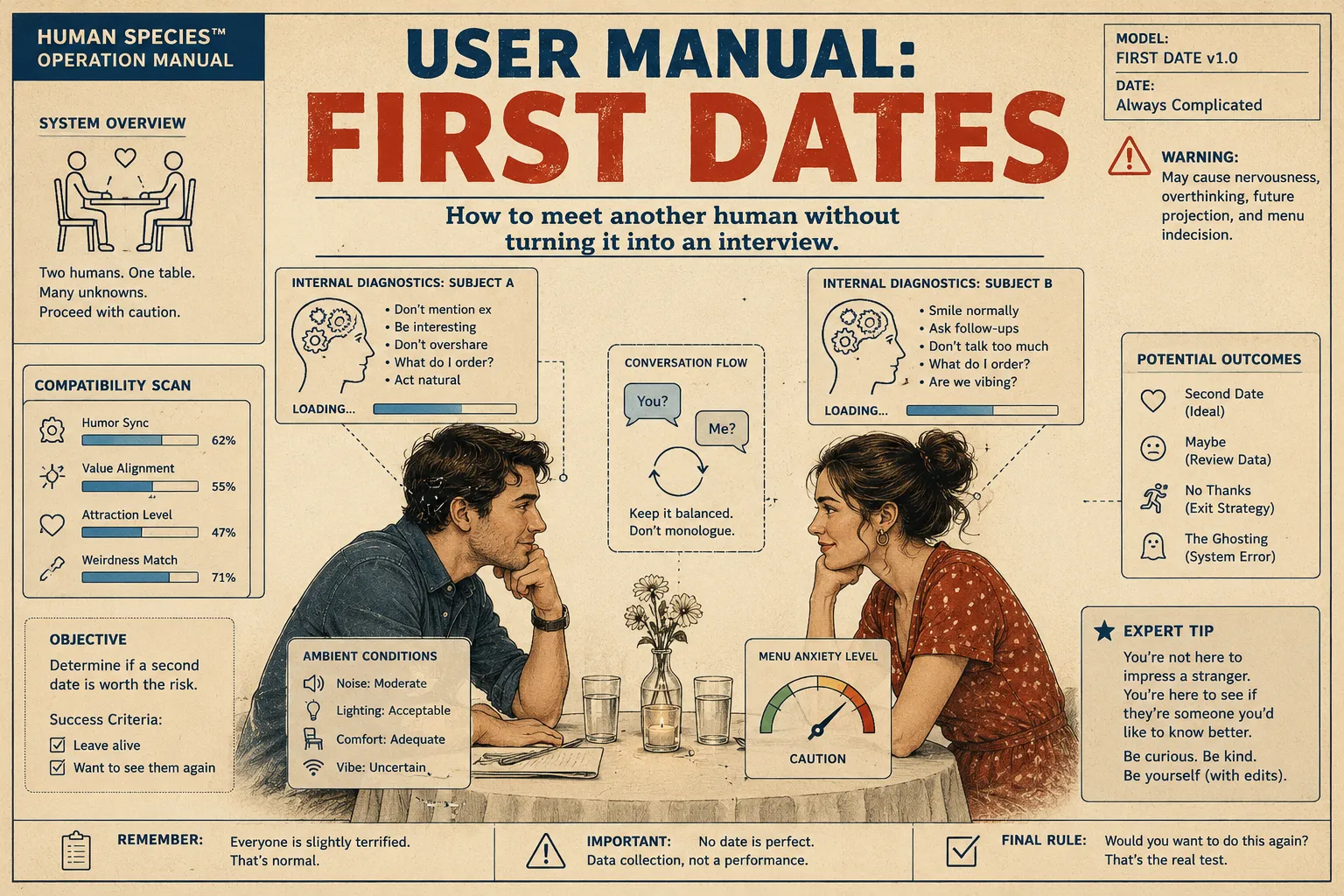
First dates were designed to help two people determine whether they enjoy each other’s company. In practice, they involve rehearsed stories, menu anxiety, accidental interviews, and both people pretending not to evaluate everything.
First dates appear simple in the official documentation.
Two humans select a location, arrive at approximately the same time, exchange information, and determine whether they would like to repeat the experience.
Actual operation may include wardrobe recalculations, emergency friend updates, menu-based panic, rehearsed anecdotes, prolonged eye-contact analysis, and the sudden loss of every interesting fact you have ever known about yourself.
This manual explains how first dates are intended to function, why they frequently malfunction, and how to leave the interaction with your dignity and basic communication systems intact.
Feature Description
A first date is an introductory social encounter between two people who may be considering romantic compatibility.
It is not technically:
- A marriage interview
- A background investigation
- A five-year planning meeting
- A courtroom deposition
- A performance review with appetizers
- Proof that either person has discovered their future partner
The first date is an early compatibility test conducted under unusually artificial conditions.
Both participants are expected to behave naturally while being fully aware that their natural behavior is currently being reviewed.
This design flaw remains unresolved.
Intended Function
The intended purpose of a first date is to answer a relatively modest question:
Do we enjoy being around each other enough to do this again?
The system was not designed to determine whether someone is your soulmate before dessert.
When operating correctly, a first date can help both people observe:
- Whether conversation feels comfortable
- Whether interest appears mutual
- Whether humor is compatible
- Whether basic values immediately conflict
- Whether both people listen
- Whether attraction exists
- Whether either person is rude to the staff
- Whether a second meeting sounds appealing rather than legally required
A successful first date does not always produce fireworks.
Sometimes it simply produces curiosity.
Curiosity is an acceptable result.
Setup Requirements
Before beginning a first date, confirm that the following conditions are present:
- Both participants know it is a date. Ambiguous meetings may accidentally activate the friendship interface.
- A time and location have been selected. “We should hang out sometime” is not a functioning reservation system.
- The setting allows conversation. Extremely loud music may force both participants to communicate through smiling and repeated use of the word “what?”
- Basic expectations are reasonably aligned. One person should not believe this is coffee while the other has mentally booked a shared vacation.
- Each participant has a safe and independent way to leave. Romance should not require transportation-based captivity.
- Neither participant expects perfection. Humans perform poorly when every sentence is treated as evidence in a future relationship trial.
Standard Operating Procedure
For basic first-date operation, use the following sequence:
- Arrive reasonably close to the agreed time.
- Greet the other person like someone you are pleased to see.
- Ask questions that require more than a one-word answer.
- Listen long enough to understand the response.
- Share information without delivering your complete autobiography.
- Observe how the interaction feels rather than constantly grading it.
- End the date clearly and respectfully.
- Decide whether you want another date after your nervous system has returned to normal.
The first date does not need to be impressive.
It needs to be real enough that both people can make an informed decision.
Common Malfunctions
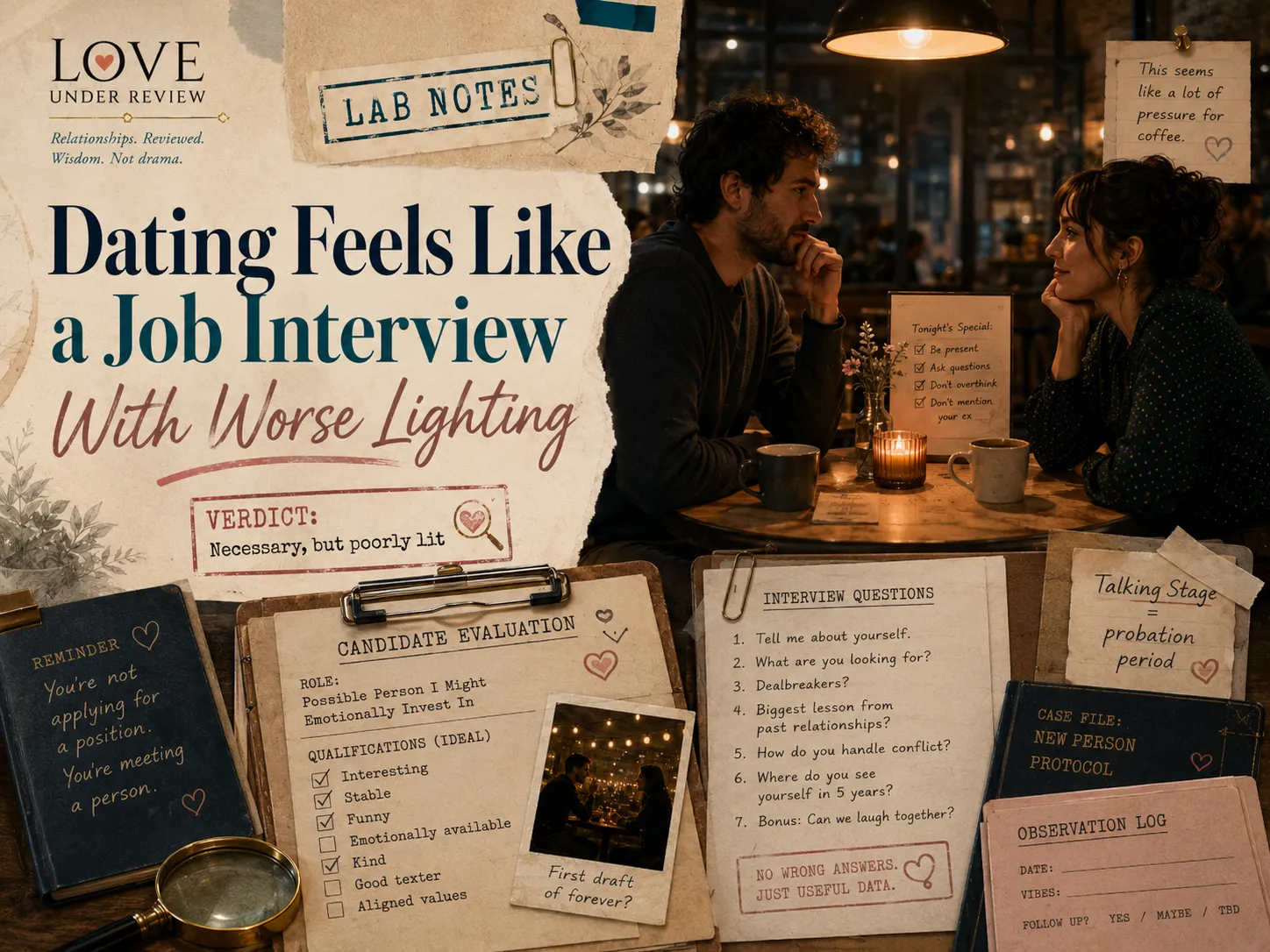
Malfunction 1: Interview Mode
Symptoms:
- Rapid-fire questions
- No conversational follow-up
- Excessive discussion of goals, income, or five-year plans
- Feeling as though a clipboard should be present
Questions are useful, but the date should not feel like a hiring process for the position of Future Partner.
Recommended fix: Respond to the answer before asking the next question.
Conversation should resemble tennis, not a police interrogation.
Malfunction 2: Performance Mode
Some users attempt to present a flawless demonstration version of themselves.
Common performance features include:
- Carefully tested stories
- Artificial confidence
- Strategic opinions
- Pretending to enjoy an activity they dislike
- Acting significantly less strange than usual
This may temporarily improve presentation quality while reducing long-term compatibility data.
A first date should show the polished version of the real person, not an entirely fictional operating system.
Malfunction 3: Oversharing During Initial Setup
Honesty is useful.
Providing the complete emotional history of every previous relationship before the drinks arrive may exceed the first date’s recommended processing limits.
This does not mean difficult topics are forbidden. It means trust and disclosure usually work better when installed gradually.
Malfunction 4: The Ex Archive Opens Automatically
Previous relationships may appear naturally in conversation.
Repeatedly discussing an ex can make the other person wonder whether the date has accidentally become a support group.
Recommended limit: Enough context to be honest. Not enough detail to make the absent person feel like the third participant.
Malfunction 5: Future Projection
A pleasant forty-five-minute conversation may cause some users to imagine:
- A second date
- A relationship
- Shared holidays
- Matching furniture
- Whether the other person’s last name is difficult to spell
This is a common forecasting error.
Positive first-date data does not guarantee long-term system compatibility.
Malfunction 6: Chemistry Panic
Not every meaningful connection begins with immediate intensity.
Some people feel instant attraction. Others become interested after familiarity develops.
The absence of dramatic sparks does not automatically indicate failure.
However, “I actively want to leave” remains important diagnostic information.
Malfunction 7: Mutual Evaluation Awareness
Both participants may become so focused on whether they are being liked that neither notices whether they actually like the other person.
This is one of the most common first-date errors.
The correct question is not only:
Do they approve of me?
It is also:
How do I feel when I am around them?
Recommended Conversation Topics
Compatible first-date topics may include:
- Hobbies and interests
- Work, without conducting a financial audit
- Places you have lived or visited
- Food preferences
- Books, movies, music, or games
- Family in broad, appropriate terms
- Goals and interests
- Funny everyday experiences
- Opinions that do not require immediate international mediation
The goal is not to cover every subject.
The goal is to discover where the conversation naturally becomes more interesting.
Topics Requiring Careful Handling
The following topics are not universally prohibited, but may require appropriate timing and awareness:
- Previous relationships
- Marriage expectations
- Children
- Religion
- Politics
- Finances
- Trauma
- Medical history
- Detailed complaints about dating apps
- Why every former partner was apparently the problem
Important compatibility questions should eventually be discussed.
The first ten minutes may not require the complete questionnaire.
Compatibility Issues
First dates behave differently depending on the participants.
One person may prefer:
- Coffee and a short conversation
- Dinner with a clear plan
- An activity that reduces direct eye contact
- A walk in a public place
- A video call before meeting
- Enough structure to prevent prolonged silence
Another person may interpret those same formats differently.
Coffee may feel low-pressure to one person and low-effort to another.
Dinner may feel romantic to one person and like an extended hostage situation to another.
Compatibility includes not only attraction, but also preferred pacing, communication style, humor, energy, and social comfort.
Troubleshooting Guide
Problem: The conversation keeps stopping
Use the last thing the person said rather than launching an unrelated emergency question.
Instead of:
“What is your favorite movie?”
Try:
“You said you like old horror movies. How did you get into those?”
Follow-up questions create conversation. Question lists create paperwork.
Problem: You are extremely nervous
Acknowledge internally that nervousness is expected.
The other person may also be operating with limited processing power.
Focus on learning one thing at a time rather than trying to control the full outcome.
Problem: You cannot tell whether the date is going well
Look for practical evidence:
- Are both people contributing?
- Are questions being returned?
- Is the conversation becoming easier?
- Has either person repeatedly checked the nearest exit?
- Does the interaction feel respectful?
- Does more time together sound pleasant?
No single sign provides a guaranteed result.
Problem: You are not interested
You are not required to manufacture attraction because the other person was kind.
Kindness deserves respect, not a romantic contract.
End the date politely and communicate clearly afterward.
Problem: You are interested but unsure whether they are
Avoid attempting to decode every facial expression, pause, punctuation choice, and beverage selection.
A simple follow-up message is more accurate than a three-hour private investigation.
Problem: You said something awkward
Most first dates contain at least one sentence that should have remained in draft mode.
Recover normally.
A brief laugh or correction is usually more effective than a fifteen-minute explanation.
Known Bugs
The following first-date issues remain unresolved:
- Humans may forget ordinary facts about themselves when asked directly.
- Silence may feel ten times longer than it actually is.
- Both participants may wait for the other person to initiate physical contact.
- One awkward moment may overshadow forty good minutes.
- Strong attraction may temporarily disable judgment.
- Nervousness may be mistaken for disinterest.
- Confidence may be mistaken for compatibility.
- Politeness may be mistaken for romantic interest.
- A person may seem completely different by text.
- The bill may create an unexpected diplomatic negotiation.
- The phrase “We should do this again” may be sincere, automatic, or legally meaningless.
- Post-date message timing may trigger unnecessary strategic planning.
No stable patch has been released.
User Warning
Warning: First dates may cause excessive outfit changes, temporary personality loss, false future projections, menu indecision, accidental oversharing, and repeated phone consultation with trusted friends.
Do not operate while attempting to become whoever you think the other person wants.
Do not confuse anxiety with chemistry.
Do not treat basic respect as rare romantic evidence.
Do not assume one pleasant evening proves permanent compatibility.
Final Manual Note
A first date is not a final exam.
It is two people collecting early information while trying not to appear as though they are collecting early information.
The goal is not to perform perfectly, force chemistry, or predict the entire future.
Show up. Be curious. Pay attention. Let the other person be real, and allow yourself to be real enough to be evaluated accurately.
Then ask the only question the first date was actually designed to answer:
Would I like to spend time with this person again?
All other upgrades can be considered later.