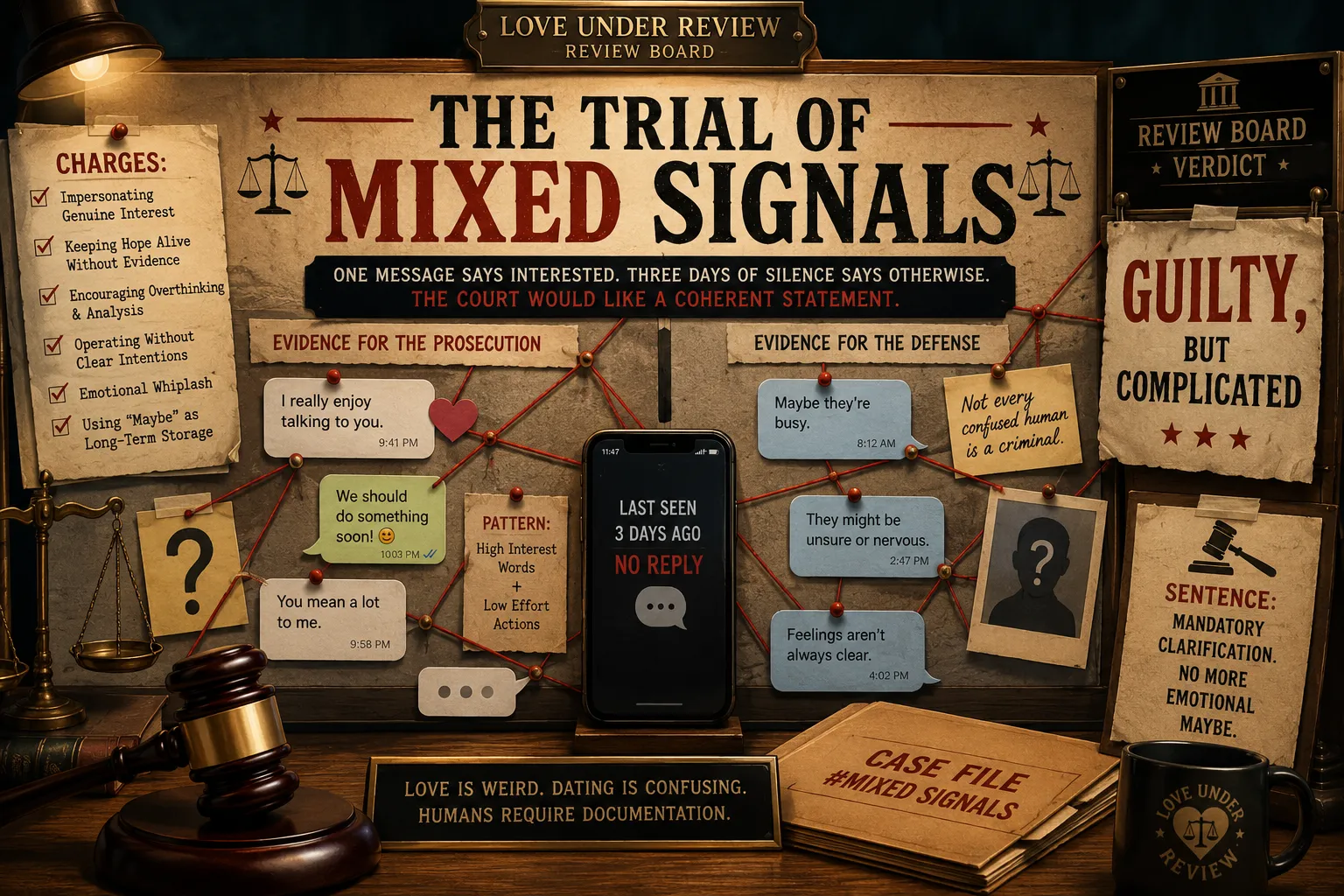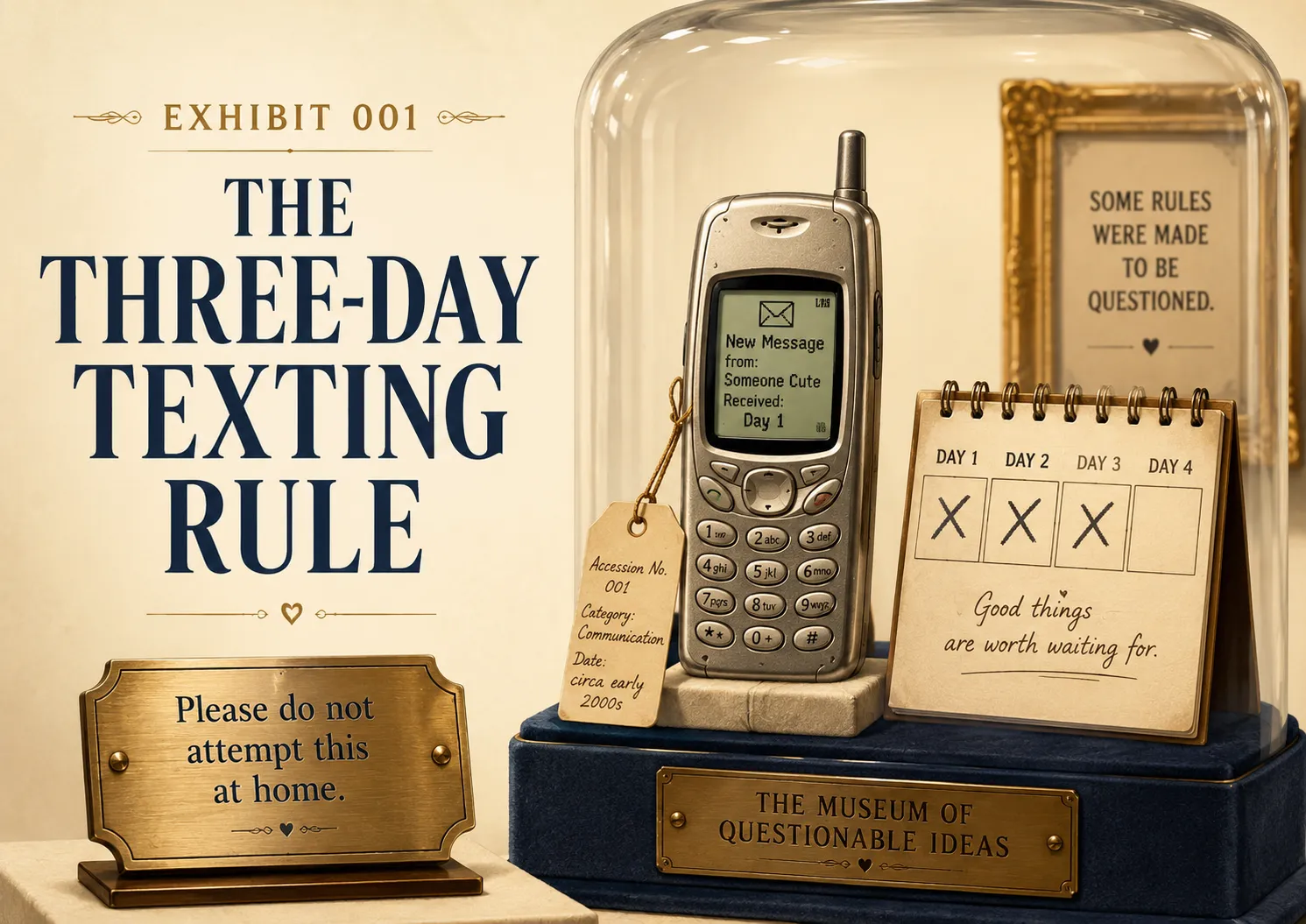
The three-day texting rule promised mystery, control, and protection from looking too interested. Instead, it often turned basic communication into a countdown filled with unnecessary uncertainty. Exhibit 001 examines why people followed it, what little value it contained, and why it now belongs behind glass.
Somewhere inside the Museum of Questionable Ideas sits an old communication device beside a calendar with three days aggressively crossed out.
The attached instructions are simple:
You had a good time. You would like to speak to the person again. Under no circumstances should you behave accordingly.
Welcome to Exhibit 001: the Three-Day Texting Rule.
Once treated as a respectable dating strategy, this rule instructed interested humans to wait approximately three days before contacting someone after a date. The purpose was supposedly to appear calm, mysterious, confident, and not remotely concerned about whether the other person wanted to see you again.
In practice, it frequently produced two people staring at their phones while pretending not to care.
Description
The Three-Day Texting Rule belongs to a larger collection of dating customs built around strategic delay.
Under the rule, contacting someone too quickly could make you appear overly interested. Waiting created the impression that you had a busy life, numerous romantic options, and perhaps several important meetings that prevented you from typing eleven words.
The rule turned communication into a timing exercise.
Interest was acceptable, but it had to be carefully concealed. Excitement was understandable, but it could not be detected. A person was expected to show enough attention to keep the connection alive while also appearing detached enough to protect their market value.
Dating became less about whether two people enjoyed each other and more about whether either person could survive the required waiting period.
Why Humans Believed It
The rule was attractive because it offered certainty in a situation filled with uncertainty.
After a promising date, a person may wonder whether the other person had the same experience. They may worry about appearing eager, misreading the situation, or being rejected after making the first move.
The three-day rule provided a procedure.
Instead of deciding what felt natural, people could follow a countdown. Instead of risking immediate rejection, they could postpone the moment when they might receive an answer they did not want.
It also relied on the idea that scarcity creates value. If attention was withheld, the other person might become more curious. If interest was hidden, the person hiding it might appear more desirable.
This occasionally worked, which is how many questionable ideas survive.
A strategy does not need to work consistently. It only needs to work once for someone who is willing to tell everyone else about it.
Original Use
At its most charitable, the three-day rule attempted to prevent impulsive behavior.
A little space after a date can be useful. It gives both people time to think about what happened instead of immediately drafting a complete romantic future based on one appetizer and forty-seven minutes of conversation.
The instinct behind the rule was not entirely unreasonable:
Do not panic. Do not send fourteen messages. Do not demand immediate reassurance. Allow the other person to have a life.
Unfortunately, reasonable restraint became an arbitrary deadline.
There is a considerable difference between taking a moment to collect your thoughts and deliberately withholding a normal message because the calendar has not granted permission.
How It Got Weird
The rule became strange when waiting stopped being about emotional self-control and started becoming a performance.
The person who cared less appeared to have more power.
Responding quickly could be interpreted as desperation. Taking hours or days to respond could be interpreted as confidence. Communication was judged not only by what was said, but by how long someone successfully resisted saying it.
This created a system in which sincerity could lower your perceived value.
Two people could enjoy the same date, want the same outcome, and still spend several days manufacturing distance because neither wanted to appear more interested than the other.
The rule was especially effective at creating confusion when both people followed it.
One person waited to avoid looking eager. The other interpreted the silence as disinterest and began moving on. By the time the approved contact window arrived, the conversation had already entered its archaeological phase.
Damage Report
The Three-Day Texting Rule has been linked to several recurring forms of romantic confusion.
It encourages people to treat ordinary enthusiasm as a weakness. It creates unnecessary anxiety after otherwise enjoyable dates. It rewards strategic silence over clear communication. It can make a genuinely interested person appear unavailable, careless, or uninterested.
Most importantly, it shifts attention away from the actual question:
Do these two people enjoy talking to each other?
Instead, everyone begins reviewing timestamps, calculating response intervals, and interpreting silence like a government intelligence report.
The rule does not remove uncertainty. It gives uncertainty a schedule.
Any Redeeming Value?
There is a small piece of useful advice trapped inside this exhibit.
Not every feeling requires immediate action. People should be allowed to finish work, spend time with family, sleep, think, and exist away from their phones. A pause can prevent impulsive oversharing or a message sent purely to relieve anxiety.
But a pause should come from self-awareness, not a mandatory three-day waiting period.
There is nothing inherently wrong with contacting someone after a date while the memory is still fresh. There is also nothing inherently wrong with waiting until the next day.
The questionable part begins when timing becomes a strategy designed to manipulate how much interest another person believes you have.
A healthy amount of restraint may be useful.
A ceremonial silence period is probably unnecessary.
Museum Verdict
Guilty, but complicated.
The Three-Day Texting Rule recognized that impulsiveness can create problems, but it responded by making normal communication suspicious.
Its sentence is permanent retirement from active dating policy.
The rule may remain in the museum as a reminder of the period when two adults could like each other and still consider speaking too soon a serious strategic mistake.
Visitors are permitted to photograph the exhibit.
They are not encouraged to follow the instructions.