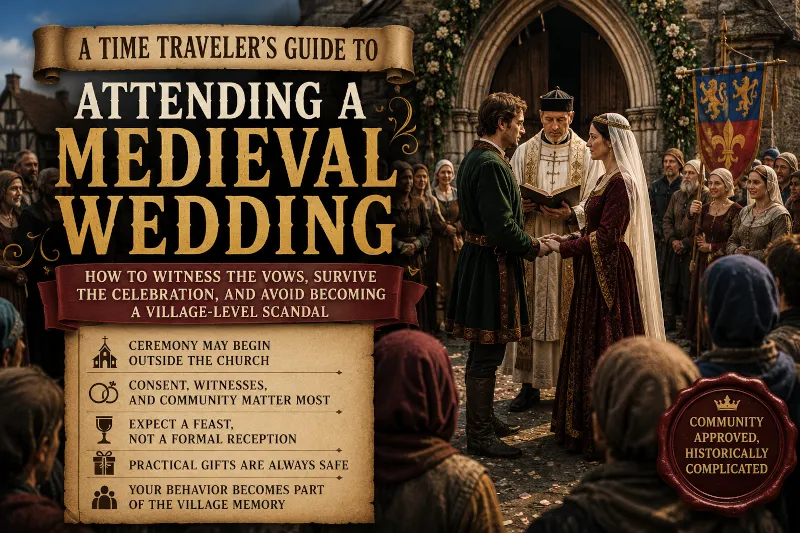
You have been invited to a wedding in late-medieval England. Do not expect a white gown, a castle banquet, or a ceremony resembling a modern wedding with worse plumbing. This field guide explains what may happen, what matters legally, and how not to insult both families.
You have arrived in late-medieval England carrying a wrapped toaster, a formal outfit purchased online, and the confident assumption that a wedding is about to happen inside a church.
Please lower your expectations and hide the toaster.
The invitation is verbal. The dress code is unclear. Nobody has created a wedding website, and asking where the couple registered will cause several people to wonder whether you are collecting taxes.
Your mission is to attend a marriage celebration without interrupting the vows, offending the families, mistaking a property negotiation for small talk, or loudly asking when the bride will change into her white dress.
Field Note: “Medieval Wedding” Is Not One Universal Event
This guide sends you to England sometime between approximately 1350 and 1450.
Even within that narrower destination, wedding practices varied by region, wealth, social status, local custom, and century. A noble family arranging a politically useful marriage did not celebrate exactly like two villagers combining households.
The Middle Ages lasted for centuries and covered many cultures. There was no single medieval wedding package with standard vows, matching decorations, and an approved playlist.
This guide therefore describes broad practices associated with later-medieval English Christian marriage—not every ceremony experienced by every person.
Mission Briefing: Determine Whether the Couple Is Already Married
Before congratulating anyone, establish what stage of the relationship you have entered.
The couple may be:
- Discussing a possible match
- Formally betrothed
- Negotiating property or family arrangements
- Preparing to exchange consent
- Publicly solemnizing a marriage already considered binding
- Celebrating with relatives and neighbors
- Disputing what one of them promised six months ago
The distinction matters.
Under later-medieval church law, the mutual consent of the couple was central to forming a valid marriage. A public ceremony, witnesses, family participation, and a priest’s blessing could make the union easier to recognize and defend, but the couple’s words of consent carried enormous weight.
This created a problem that remains familiar to modern humans:
Two people could remember the same conversation very differently.
One person might believe they discussed a future possibility.
The other might believe they became legally married beside a storage shed.
Your first survival rule is therefore simple:
Do not casually repeat marital vows as a joke.
Medieval relationship status settings have fewer warning screens than your phone.
The Ceremony May Begin Outside the Church
You have reached the church, but everyone appears to be gathering near the entrance.
This is not necessarily a scheduling error.
Marriage ceremonies in medieval England could be solemnized near the church door before the couple and their guests entered for a religious service or blessing. The entrance created a public setting where the union could be witnessed by the surrounding community.
The doorway represented an appropriate boundary between the public agreement and the sacred space inside.
It was also useful because the village could see exactly who had married whom.
Privacy was not the primary feature.
A priest might ask whether there were lawful reasons the marriage should not proceed. The couple could exchange consent, and a ring might be blessed and given depending on the place and period. The party could then move inside for prayers or Mass.
Do not stand in the doorway checking whether the building has better lighting.
You are blocking the legal event.
What Counts as Romantic Here?
A modern wedding may celebrate an established romantic relationship. A medieval marriage could involve affection, family strategy, property, labor, inheritance, social security, political alliance, or some combination of all six.
Romance existed. Medieval people wrote love poetry, experienced longing, made impulsive promises, pursued unsuitable partners, and disappointed their families.
They were not emotionally unfinished prototypes.
However, marriage often carried responsibilities extending far beyond personal compatibility. It could determine where people lived, how property passed, which households cooperated, who inherited, and what work each spouse was expected to perform.
What counts as romantic may therefore include:
- Publicly choosing and accepting one another
- Giving a ring or another meaningful token
- Creating a household together
- Receiving the approval or support of relatives
- Hosting a meal that demonstrates generosity
- Dressing in one’s finest available clothing
- Walking together before the community
- Promising loyalty where everyone can hear it
The romantic gesture is not necessarily a dramatic surprise.
Sometimes it is agreeing to share grain storage.
Family Approval Is Important—but Consent Still Matters
You may notice that several relatives are discussing land, livestock, money, tools, clothing, household goods, or inheritance.
They have not forgotten the romance.
This may be how they understand the romance.
Among wealthy and politically important families, marriages could strengthen alliances, settle disputes, connect estates, and protect dynastic interests. Among ordinary households, marriage still had economic consequences. Two people were not merely combining feelings; they were reorganizing labor, resources, obligations, and living arrangements.
Parents and guardians could exert substantial pressure, especially on younger people and women. Lords could also exercise authority over unfree tenants. Some serfs faced a payment known as merchet when a daughter married, reflecting the manor’s claim over labor and household arrangements.
Despite that social pressure, church law increasingly emphasized the consent of the marrying couple.
This did not create modern freedom or equality.
It did create the possibility that a couple’s own words could carry legal force—even when those words produced a situation their relatives strongly disliked.
In other words, medieval families also experienced the phrase:
“We need to talk about what you two have done.”
Clothing Hazard: The Bride May Not Be Wearing White
Do not look for a modern white wedding gown.
White bridal clothing was not the universal medieval standard. A bride would generally wear clothing appropriate to her status and resources, often emphasizing quality, color, decoration, or valuable fabric rather than conforming to a single bridal shade.
A wealthy bride might display expensive textiles, embroidery, jewelry, fur, or a decorated headdress. Someone with fewer resources might marry in her best available clothing and expect to wear those garments again.
This is practical.
A dress that can only be worn once is difficult to justify when every piece of fabric required significant labor.
The groom may also dress in his best garments rather than purchasing a costume designed exclusively for the ceremony.
As a time traveler, avoid arriving dressed like a fantasy-warrior interpretation of the Middle Ages.
You are attending a wedding, not defending the northern wall.
Recommended clothing strategy:
- Wear clean, respectable garments suitable for your assumed status.
- Avoid colors and materials so luxurious that you appear to outrank your hosts.
- Remove your smartwatch.
- Do not carry a sword unless everyone believes you are authorized to carry a sword.
- Accept that pockets may not function as expected.
What Not to Say During the Ceremony
Avoid the following statements:
“I object!”
You are not performing a movie scene. Unless you know of a genuine legal or religious impediment, remain silent.
“When do they sign the marriage certificate?”
The paperwork systems you recognize do not yet exist in their modern form.
“Did her father give her away?”
Family involvement may be substantial, but medieval marriage cannot be reduced to one modern ceremonial phrase.
“Is this an arranged marriage or a love marriage?”
The answer may not fit neatly into either category. Family strategy and personal attachment can exist in the same relationship.
“Where is the maid of honor?”
The people assisting the bride are unlikely to use your exact terminology or wear matching dresses selected through a group message.
“Are they doing the handfasting part?”
Do not treat every image from a modern medieval-themed wedding as universal historical practice.
“When does the reception start?”
The meal, procession, blessing, music, visiting, and community celebration may not be divided into the same scheduled blocks as a modern event.
You have not received a printed timeline.
You must follow the crowd like everyone else.
The Community Is Part of the Marriage
A medieval marriage was not purely private.
The surrounding community might witness the consent, recognize the new household, celebrate the match, remember the promises, and later provide testimony if a dispute reached a church court.
This gave public behavior unusual importance.
If one spouse later denied the marriage, witnesses might be asked what they heard, where the vows occurred, what words were used, whether gifts were exchanged, and how the couple behaved afterward.
Your casual observation could eventually become evidence.
This means you should remain alert during the ceremony rather than attempting to document it with a device no one understands.
The community is already recording the event.
The storage system is human memory, which remains unreliable but surprisingly confident.
Gifts: Do Not Present an Appliance
Wedding gifts might involve household goods, money, clothing, livestock, property, food, or other useful contributions depending on the couple’s status and local customs.
A toaster presents several problems:
- There is no electrical supply.
- Sliced bread is not operating under modern standards.
- You cannot explain the heating elements.
- The local authorities may classify it as either useless or demonic.
Select something the household can understand.
Safer possibilities include:
- A useful cup, bowl, or vessel
- Good cloth
- Food or drink
- A practical household object
- Money recognizable in the destination
- Labor or assistance with the celebration
Do not give the couple matching novelty mugs declaring them king and queen.
Actual royal titles are still taken seriously.
The Wedding Feast Depends on the Household
You may have pictured a great hall filled with roasted animals, musicians, banners, endless wine, and one suspicious court jester.
That celebration exists mainly at the wealthier end of the social scale.
An elite marriage could involve substantial hospitality, public display, processions, music, entertainment, and meals intended to demonstrate status. A modest village wedding might involve relatives, neighbors, locally available food, drink, and a celebration shaped by the household’s actual resources.
The purpose of the meal is not merely to feed the guests.
Hospitality demonstrates the families’ ability to provide, strengthens community relationships, and publicly marks the creation of a new household.
Your task is to eat what is offered without asking whether there is a vegetarian entrée, a children’s menu, or an online review page.
Also remember that table manners, seating, serving order, and the quality of food can reveal social rank.
Do not take the highest seat because it has the best view.
That seat belongs to someone whose family owns the view.
Social Consequences: Do Not Start a Rumor
You have consumed an uncertain quantity of ale and learned a surprising amount about the families.
Now is the dangerous part.
Marriage affects reputation, inheritance, legitimacy, property, religious obligations, and community order. A rumor about a secret promise, previous betrothal, forbidden degree of kinship, or existing spouse could create serious consequences.
Do not casually announce:
“I heard she was practically engaged to someone else.”
You may have transformed a wedding feast into future litigation.
You should also avoid flirting conspicuously with members of either family, criticizing the match, insulting the food, questioning the bride’s reputation, or suggesting that marriage is merely a temporary lifestyle experiment.
Modern wedding guests may create awkward stories.
Medieval wedding guests can create evidence.
What Sounds Better Than a Modern Wedding?
There are appealing parts.
The celebration can feel connected to the surrounding community rather than designed primarily for photographs. Clothing may be reused. Gifts can be practical. The central agreement can be spoken in direct language. The creation of a household is treated as a meaningful social event rather than a private relationship update.
There may also be less pressure to produce a perfectly coordinated visual experience.
Nobody is comparing the flower arrangements with forty thousand professionally photographed weddings.
Nobody has created a custom hashtag.
Nobody is performing a choreographed dance because the algorithm might reward it.
The couple must still impress their community, but they are not competing with the entire internet.
That sounds peaceful.
What Sounds Terrible?
The lack of modern freedom.
Family interests, social class, economic survival, gender expectations, religious law, property systems, and local authority could heavily restrict personal choices.
Women often faced unequal rights and consequences. Separation was difficult. Marriage could determine a person’s labor, residence, resources, and future with limited room for revision. Community recognition offered support, but it also created surveillance.
There was no simple legal system allowing every unhappy couple to dissolve the marriage and reorganize their lives fairly.
Romantic lighting does not remove structural inequality.
The wedding may look beautiful in a manuscript illustration.
That does not mean everyone inside the image had equal power.
Survival Tips for the Medieval Wedding Guest
Before entering the celebration, remember:
- Confirm the destination. Medieval England is not one uniform culture or century.
- Do not joke with marital vows. Consent can carry more legal weight than you expect.
- Look near the church entrance. The ceremony may begin outside.
- Dress respectfully, not theatrically. You are a guest, not a background knight.
- Do not expect a white gown. Wearable wealth matters more than modern bridal uniformity.
- Follow the community’s lead. There is no printed itinerary.
- Give something useful. Leave the electrical appliances in the return portal.
- Avoid creating rumors. Your conversation may become church-court testimony.
- Respect the economic reality. Marriage creates a household as well as a couple.
- Do not romanticize the restrictions. Public tradition and personal freedom are not the same thing.
Modern Comparison: The Wedding Changed, but the Questions Survived
Modern weddings and medieval weddings use different objects, laws, clothing, and rituals.
The underlying questions remain recognizable:
Do both people truly consent?
Do their families support the marriage?
Can the couple build a stable household?
What does each person expect afterward?
Who is paying for the celebration?
Where will everyone sit?
Which relative is already causing a problem?
Technology has changed the planning process.
Human family behavior has shown impressive resistance to updates.
The medieval family argues about land, household goods, and inheritance.
The modern family argues about the guest list, hotel blocks, and whether someone’s new partner should appear in the photographs.
Different century.
Same Review Board.
Return Portal Notes
The medieval wedding receives credit for treating consent as meaningful, involving the community, making practical gifts respectable, and understanding marriage as the creation of a shared household.
It loses points for unequal power, class restrictions, financial control, family pressure, limited privacy, and requiring a legal historian to determine whether two people became married during a conversation near a barn.
Review Board verdict: Community approved, historically complicated.
Bring home the direct promises, useful gifts, reusable clothing, and willingness to support a new household.
Leave behind the manorial fees, property negotiations, rigid gender roles, and the possibility that a poorly worded private conversation has already married you.
Before entering the return portal, check once more that you did not promise yourself to anyone.
Medieval customer support is no longer available.