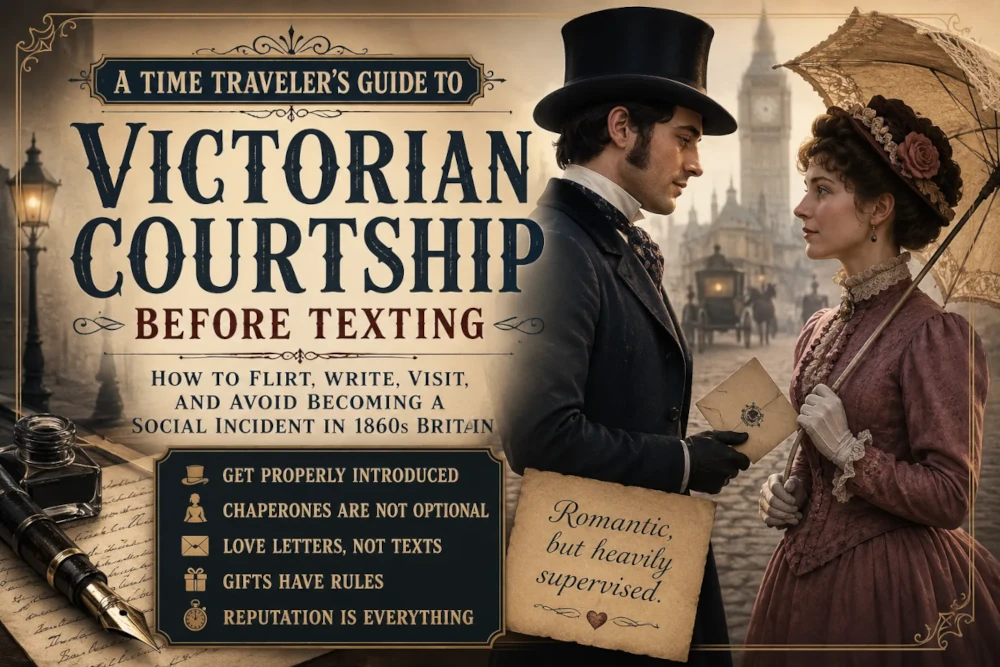
You have arrived in Victorian Britain with a smartphone, no chaperone, and dangerously casual opinions about introductions. This field guide explains how respectable courtship worked, what could damage a reputation, and why waiting for a letter was sometimes faster than waiting for a modern text.
You have arrived in Victorian Britain with a fully charged smartphone, three dating apps, and the dangerous belief that you may simply introduce yourself to someone you find attractive.
Please put the phone away.
It cannot connect to anything, its camera may cause a disturbance, and explaining that you meet romantic prospects by sliding photographs across a glass rectangle will not improve your social standing.
Your destination is middle-class Victorian Britain, approximately 1860 to 1880. This is not a world without romance. People flirt, fall in love, exchange letters, endure rejection, make terrible decisions, and become emotionally attached to people their families find unsuitable.
The difference is that they do many of these things while being watched.
Field Note: Not Every Victorian Followed the Same Rules
This guide focuses primarily on the formal etiquette promoted to respectable middle- and upper-class British society. Customs differed by class, location, religion, family, and circumstance.
Etiquette manuals described how people were supposedly expected to behave. Human beings, as usual, remained capable of ignoring the documentation.
Consider this the official operating manual—not proof that every user followed the instructions.
Mission Briefing: You Are Not Casually Dating
Modern dating often begins with a low-risk message:
“Hey.”
Victorian courtship ideally began with considerably more infrastructure.
A respectable courtship was generally expected to have marriage somewhere in its possible future. A gentleman was advised to consider his financial position, prospects, family connections, and seriousness before deliberately seeking a woman’s affection.
In other words, “Let’s just see where this goes” was not an especially impressive mission statement.
The family was not background scenery. The family was the application process, security department, character-reference system, and terms of service.
Your first objective is therefore not to impress your romantic interest.
Your first objective is to become someone the household will allow through the front door.
Step One: Secure a Proper Introduction
Do not walk across a ballroom, offer your hand, and say, “I saw you from over there.”
You have not been introduced.
In respectable Victorian etiquette, an introduction carried weight. The person arranging it was effectively vouching for the respectability of both parties. A potential suitor might seek an introduction through a mutual friend and, if his intentions became serious, gain access to the woman’s family circle.
This creates a problem for the modern time traveler.
Your usual credentials—social media profile, employment page, mutual followers, and one flattering photograph taken from slightly above eye level—have no authority here.
You need a real person willing to say:
“I know this man, and allowing him into the drawing room will probably not result in scandal.”
That is the Victorian equivalent of being verified.
What Counts as Romantic Here?
Romance has not disappeared. It has simply acquired paperwork and witnesses.
Acceptable signs of interest may include:
- Seeking repeated opportunities to meet through approved social settings
- Paying respectful attention during family visits
- Demonstrating punctuality, courtesy, seriousness, and self-control
- Dancing together when properly introduced
- Writing letters once correspondence becomes appropriate
- Showing respect toward the prospective partner’s family
- Eventually stating clear intentions
Notice what is missing: prolonged ambiguity presented as emotional sophistication.
Victorian courtship could certainly contain uncertainty, secrecy, manipulation, and heartbreak. Humans were not invented in 1997. However, the formal ideal pushed courtship toward a recognizable destination.
That destination was usually marriage.
This may sound refreshing until you remember that you might have to consider marriage before learning whether the other person chews loudly.
The Chaperone Is Not a Third Wheel
You have finally arranged a meeting. The conversation is pleasant. There may even be chemistry.
Unfortunately, someone’s mother is sitting six feet away doing needlework with the alertness of a surveillance system.
Formal etiquette discouraged unmarried couples from spending significant time alone together. Meetings might occur in the woman’s family home, at a dance, during a concert, on a promenade, or in another approved social setting. A relative, guardian, or third party could remain nearby.
The chaperone is not failing to understand the mood.
Monitoring the mood is the assignment.
Your romantic conversation must therefore survive interruptions, family observation, limited privacy, and the possibility that someone nearby is evaluating your posture.
Modern couples sometimes complain that phones interfere with intimacy. Victorian couples occasionally had an entire household interfering with intimacy.
Your Texting Habit Is Now a Postal Strategy
The good news is that Victorian Britain has an impressive communications network.
The introduction of the Penny Post in 1840 made letter sending much cheaper and more accessible. In London, several deliveries could occur in a single day. A morning letter might arrive by lunchtime.
That means Victorian dating had no typing indicator, but it occasionally had same-day delivery.
A letter, however, is not a disposable message.
You must choose paper, write legibly, include the date and address, select an appropriate greeting, control your punctuation, and commit your thoughts to an object that may remain in a drawer for the next 140 years.
There is no edit button.
There is no unsend feature.
There is only ink, consequence, and the distant hope that your descendant does not donate the entire correspondence to an archive.
Prompt replies were considered polite, but courtship correspondence also required discretion. Letters could become evidence of affection, character, promises, or impropriety. If an engagement ended, returning letters and gifts could become part of separating the two lives.
A modern person may fear a screenshot.
A Victorian correspondent had to fear the original document.
What Not to Write
Avoid beginning with:
“U up?”
The postal delay has already damaged the usefulness of the question.
Also avoid language that is too intimate for the current stage of acquaintance. A private correspondence begun without family knowledge could be treated as clandestine and improper, especially within the formal standards described by etiquette writers.
Your message should not assume an intimacy that has not been socially recognized.
This is difficult for the modern traveler because modern communication frequently operates in reverse:
- Exchange private messages.
- Reveal personal fears.
- Flirt at 1:00 a.m.
- Avoid defining the relationship.
- Eventually ask for the other person’s last name.
Victorian etiquette preferred to establish identity, family, reputation, and intentions much earlier.
Neither system completely prevents disaster. They merely organize it differently.
Visiting Hours Are Not a Suggestion
You have been invited to call at the family home.
Do not arrive whenever you feel emotionally prepared.
Etiquette manuals could prescribe particular afternoon hours for social calls, and ceremonial visits were expected to remain reasonably brief. A visit lasting around half an hour could be sufficient. Staying too long risked making you seem inconsiderate or overly familiar.
This creates an unusual challenge for anyone accustomed to a first date lasting four hours because neither person knows how to end it.
Your safest procedure is:
- Arrive at an appropriate hour.
- Greet the household respectfully.
- Keep your conversation pleasant.
- Avoid behaving as though you already belong there.
- Leave before everyone begins wondering whether you live there now.
The goal is to make the family pleased to see you again.
It is not to remain until they ask whether you need a blanket.
Clothing and Etiquette Hazards
Victorian society could treat appearance as evidence of character.
A prospective suitor might be judged by cleanliness, punctuality, manners, religious observance, spending habits, treatment of family members, treatment of other women, and general seriousness. Women were subjected to their own restrictive and heavily gendered standards involving dress, temperament, domestic conduct, modesty, and family behavior.
The system did not merely ask, “Do these two people like each other?”
It asked whether each person performed the expected social role convincingly enough to be considered suitable.
As a time traveler, avoid:
- Casual clothing that appears careless
- Slang no one recognizes
- Interrupting people repeatedly
- Checking your nonexistent notifications
- Treating household staff disrespectfully
- Speaking too freely about private matters
- Announcing that marriage is merely a social construct during tea
- Explaining that your main romantic qualification is “good vibes”
Your personality may be charming in the twenty-first century.
Here, it may be entered into the family record as concerning.
Gifts Can Accidentally Become Evidence
Do not arrive with an expensive surprise gift during the early stages of acquaintance.
Formal etiquette placed restrictions on unmarried women accepting gifts from unrelated men when no engagement existed. A costly or intimate gift could imply a relationship that had not been properly established.
Flowers, books, small approved tokens, and gifts connected to an engagement might be safer depending on the situation. Extravagance could create obligation, gossip, or questions about your intentions.
The survival rule is simple:
Before presenting a gift, ask whether it communicates affection, commitment, wealth, pressure, or all four.
Modern dating still has this problem. We have simply added online order tracking.
Social Consequences: Reputation Is the Group Chat
Victorian courtship took place within networks of family, friends, neighbors, churches, employers, and social acquaintances. Reputation affected whether introductions happened, visits continued, invitations arrived, and families approved.
There was no neighborhood group chat.
The neighborhood was the group chat.
Flirting widely without serious intentions, ignoring family expectations, creating a secret correspondence, visiting improperly, breaking promises, or ending an engagement carelessly could damage reputations.
The consequences were not equal. Women often faced greater restrictions and more severe judgment. Social status and financial dependence could make romantic decisions far more consequential than they are for many people today.
This is the part of historical romance that costume dramas occasionally soften with attractive lighting.
The rules could provide clarity and structure, but they could also reduce privacy, limit freedom, reinforce inequality, and place family reputation above individual happiness.
What Sounds Better Than Modern Dating?
Victorian courtship offered at least one attractive idea: attention required effort.
A person could not maintain twelve conversations by sending the same reaction symbol to everyone.
Writing a thoughtful letter took time. Calling at a home required preparation. Seeking an introduction involved social risk. Continuing a formal courtship implied that the relationship might be moving toward a decision.
There was less technology available for creating the illusion of constant connection without actual commitment.
The system also encouraged observation. Prospective partners were advised to notice how someone treated family members, behaved around others, handled money, kept promises, and responded to ordinary responsibilities.
That remains more useful than judging compatibility entirely by whether two people enjoy the same television show.
What Sounds Terrible?
Almost everything involving autonomy.
Privacy was limited. Gender roles were restrictive. Family approval carried enormous weight. Marriage could be approached before couples had meaningful opportunities to know each other privately. Social expectations could pressure people into roles or relationships that did not fit them.
Modern dating may be confusing, but most adults now have far more freedom to choose whom they meet, how they communicate, whether they marry, and when they leave.
We should not confuse formality with fairness.
The presence of rules does not guarantee that the rules serve everyone equally.
Survival Tips for the Temporally Displaced
Before entering Victorian courtship, remember:
- Obtain an introduction. Appearing in someone’s messages is no longer a complete social strategy.
- Respect the household. You are courting within a family system, not operating a private romantic side project.
- State serious intentions carefully. Endless ambiguity will not make you look mysterious. It may make you look dishonorable.
- Write as though the letter will survive. It might.
- Expect supervision. Privacy is a future technology.
- Keep gifts modest and appropriate. Do not accidentally propose through stationery.
- Observe behavior, not only charm. This advice survives the return journey.
- Do not romanticize the restrictions. Beautiful handwriting does not cancel social inequality.
Modern Comparison: Different Technology, Familiar Humans
Victorian courtship and modern dating appear completely different until we examine the underlying behavior.
People still wait anxiously for replies.
They still interpret small changes in tone.
They still ask friends what a message means.
They still perform confidence while privately assuming they have ruined everything.
They still wonder whether affection is mutual, whether intentions are serious, whether families will approve, and whether another person’s silence means rejection or merely inconvenience.
Technology changes the speed of uncertainty.
It does not eliminate uncertainty.
The Victorian correspondent waited for the post.
The modern dater watches three dots appear, disappear, and take part of the soul with them.
Return Portal Notes
Victorian courtship receives credit for effort, intention, thoughtful correspondence, and the radical concept that behavior around other people may reveal character.
It loses substantial points for restrictive gender roles, limited privacy, social surveillance, unequal consequences, and requiring an entire committee before two people can have an honest conversation.
Review Board verdict: Romantic, but heavily supervised.
Return to the present with the handwritten letter, the habit of observing character, and perhaps the willingness to communicate clear intentions.
Leave the chaperone behind.
They have seen enough.