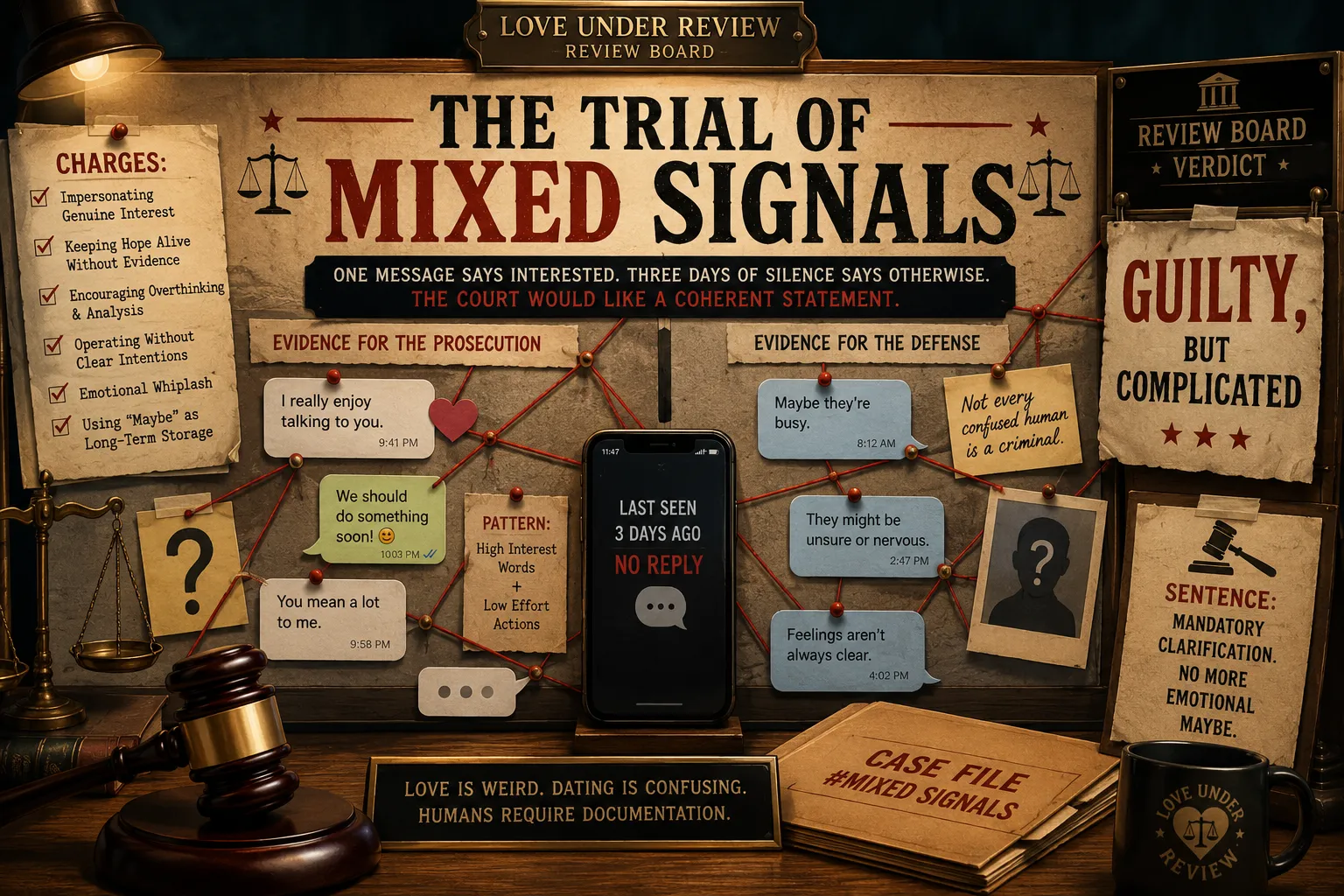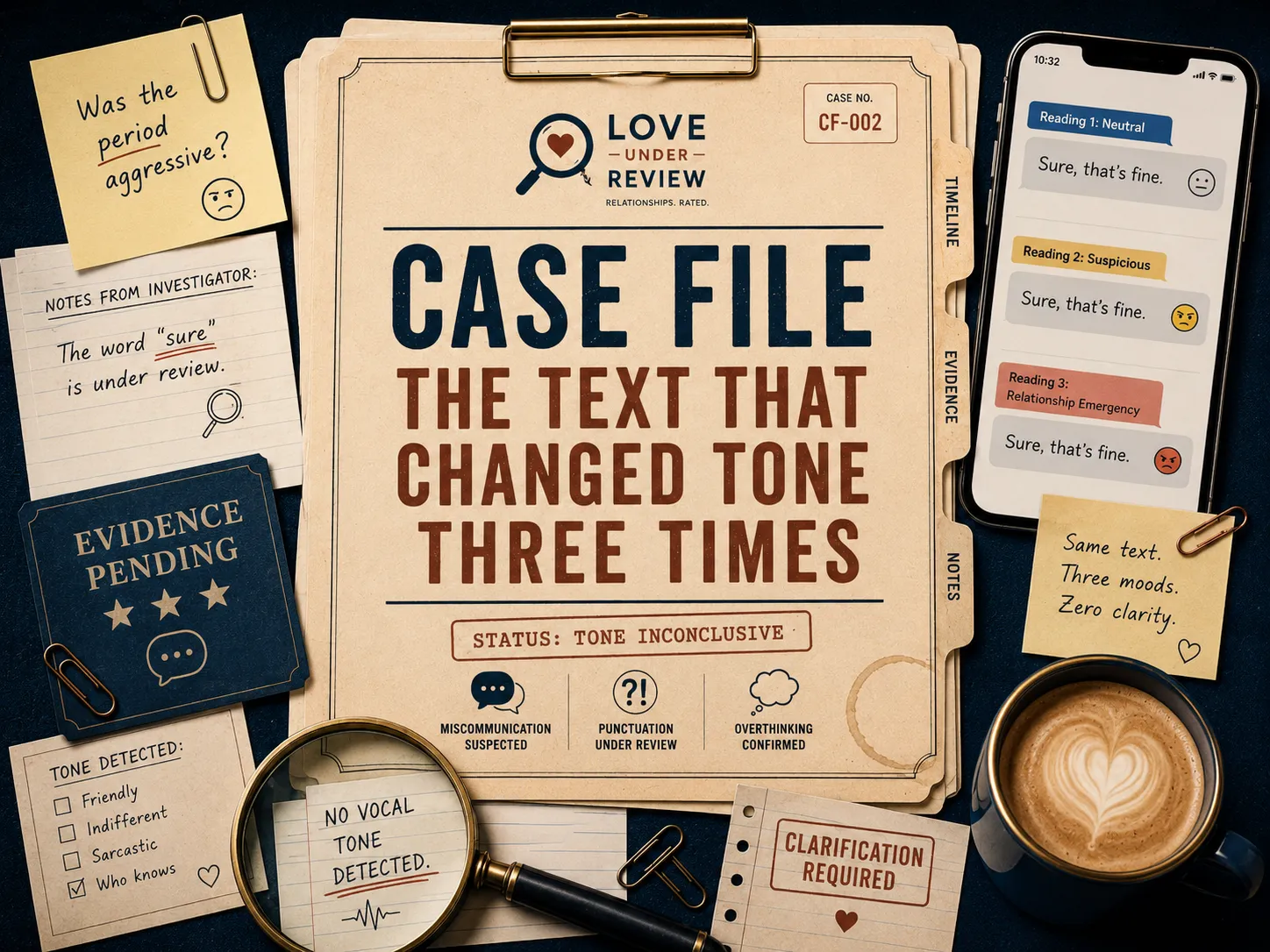
A simple text arrives without facial expression, vocal tone, or supporting witnesses. After three readings, it has somehow become an argument. The Review Board investigates how ordinary messages acquire emotional soundtracks their senders may never have intended.
Case Number: CF-002 Subject: The Text That Changed Tone Three Times Classification: Tone Ambiguity Event Current Status: Awaiting clarification
A spoken sentence arrives with a voice, a facial expression, timing, and several other pieces of evidence.
A text message arrives as a collection of letters and expects the recipient’s nervous system to direct the scene.
This is how one harmless message can be read three times and develop an entirely new personality during each investigation.
Incident Summary
The message under review appears ordinary:
“Sure, that’s fine.”
On the first reading, it sounds agreeable.
On the second reading, the word “sure” begins attracting suspicion.
By the third reading, the period has been entered into evidence as an act of emotional aggression.
The sender may have intended nothing more than agreement. The recipient, however, has now detected disappointment, irritation, distance, and possibly the early stages of a breakup.
The text has not changed.
Only its soundtrack has.
Suspected Cause
Text messages remove most of the information humans normally use to interpret one another.
There is no voice to indicate warmth. There is no smile to soften the wording. There is no immediate correction when the message lands badly.
The missing information must be supplied by the reader.
Unfortunately, the reader may be working with:
- A recent disagreement.
- An unusually long response time.
- Existing uncertainty about the relationship.
- A bad mood that began before the message arrived.
- Previous experiences with passive-aggressive communication.
- A suspiciously confident period at the end of the sentence.
Once uncertainty enters the conversation, punctuation may be asked to testify about matters far beyond its qualifications.
Common Symptoms
The tone-changing text commonly produces the following behavior:
- Reading the same message repeatedly while emphasizing a different word each time.
- Taking a screenshot and submitting it to an unofficial jury of friends.
- Typing a defensive response, deleting it, and typing something even more defensive.
- Adding unnecessary emojis to future messages as emotional bubble wrap.
- Comparing the current message with older texts to determine whether the sender has changed.
- Treating a period as evidence that someone is furious.
- Responding to the imagined tone instead of the written words.
- Asking “Are you mad?” after receiving a message that contains no identifiable anger.
In advanced cases, the recipient may create a full argument before the sender realizes a disagreement has begun.
Risk Assessment
Risk Level: Moderate
Most ambiguous texts are harmless.
The danger begins when the recipient responds to an interpretation as though it were confirmed intent.
A neutral message may receive a cold reply. The cold reply then creates actual tension. Both people begin defending themselves against a conflict that did not exist when the original message was sent.
The imagined tone becomes real because everyone starts reacting to it.
This is how a three-word text can generate a forty-minute conversation about communication.
Recommended Handling
Before replying to the angriest possible version of a message, request additional evidence.
A simple clarification may be enough:
“I can’t tell the tone. Did you mean that neutrally, or are you frustrated?”
This may feel awkward, but it is usually less awkward than launching a counterattack against punctuation.
Important or emotionally complicated conversations may also require a phone call, voice message, or face-to-face discussion. Texting is useful for transferring information. It is less reliable when the meaning depends heavily on delivery.
The sender can also reduce ambiguity by being specific:
“Yes, that works for me.”
That sentence leaves less room for the Review Board to spend the evening interrogating the word “sure.”
Review Board Finding
The text message is not automatically guilty.
It may be brief because the sender is busy. It may contain a period because the sender understands basic sentence structure. It may sound distant because written communication does not include a face.
Context still matters.
A pattern of cold, vague, or dismissive messages may provide useful evidence. One strangely interpreted sentence usually does not establish the entire case.
The Review Board therefore declines to convict tone without supporting documentation.
Review Status
Awaiting Clarification
The case may be closed when one of the following occurs:
- The sender explains what they meant.
- The recipient asks instead of assuming.
- A phone call restores the missing vocal evidence.
- Both parties agree to stop assigning emotional motives to punctuation.
- The original message is accepted as ordinary human communication.
Until then, the tone remains unconfirmed.
Final Case Note
Before responding to the third version of a text, confirm that the first two existed anywhere outside your own head.