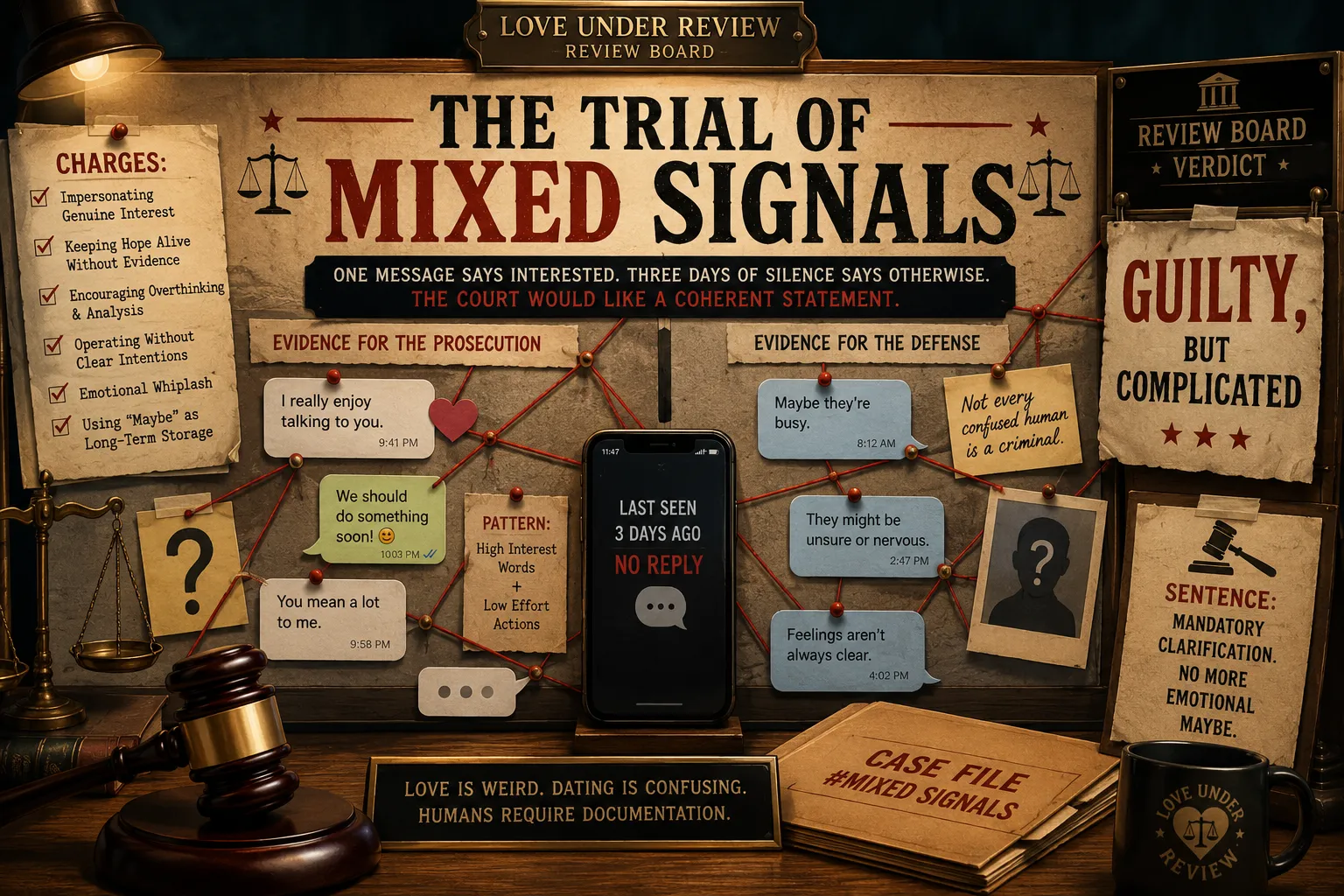
Playing hard to get promises mystery, confidence, and protection from rejection. It can also leave two interested people performing indifference until the connection quietly expires. Exhibit 002 examines where healthy pacing ends and unnecessary emotional hide-and-seek begins.
Every museum contains at least one artifact that seemed clever at the time.
This exhibit contains several unread messages, one deliberately delayed reply, a calendar full of suspiciously unavailable evenings, and two people who liked each other but refused to provide supporting evidence.
Welcome to Exhibit 002: Playing Hard to Get.
The strategy is simple: when you are interested in someone, make sure they cannot be entirely certain of that fact.
Be warm, but not too warm. Respond, but not too quickly. Accept the invitation, but perhaps only after implying that your schedule is controlled by an international committee.
The goal is to appear desirable by appearing slightly unavailable.
The risk is becoming so convincing that the other person believes you.
Description
Playing hard to get is the practice of deliberately limiting attention, availability, enthusiasm, or affection to increase another person’s interest.
It can take many forms.
A person might delay responding even though they have already seen the message. They might decline an invitation they wanted to accept. They may pretend to have less interest, more options, or a fuller schedule than reality can reasonably support.
The strategy depends on controlled uncertainty.
The other person should receive enough encouragement to remain interested, but not enough clarity to feel secure. The distance is supposed to create curiosity. The mystery is supposed to increase value.
In theory, the person becomes more desirable because they are difficult to obtain.
In practice, they may simply become difficult to communicate with.
Why Humans Believed It
Playing hard to get survives because attention can feel more valuable when it is not freely available.
People often notice what they cannot immediately have. Uncertainty can increase curiosity, and a little mystery may prevent a new connection from feeling overly intense too quickly.
The strategy also offers emotional protection.
Openly expressing interest creates the possibility of rejection. Pretending to care less can make that rejection feel less exposing. If the connection fails, the person can tell themselves they were never fully invested.
This creates an appealing illusion of control.
Instead of asking, “Do they like me?” the person becomes focused on making the other person ask the same question.
The strategy may also be mistaken for confidence. Someone who does not chase constantly, cancel their plans, or demand immediate attention can appear secure and independent.
Unfortunately, genuine confidence and performed indifference can look similar from a distance.
The difference usually becomes obvious only after everyone is confused.
Original Use
There is a reasonable instinct buried inside this exhibit.
New attraction can make people move too quickly. They may abandon routines, become constantly available, overanalyze every interaction, or treat one promising conversation like the opening chapter of a completed love story.
Maintaining your own life is healthy.
Keeping existing plans is healthy. Allowing a connection to develop gradually is healthy. Avoiding constant reassurance-seeking is healthy. Giving another person room to decide how they feel is also healthy.
None of those things require pretending not to care.
The original useful idea may have been simple:
Do not lose yourself while trying to be chosen.
That message became distorted into:
Make being chosen unnecessarily difficult.
How It Got Weird
Playing hard to get becomes questionable when natural pacing turns into calculated confusion.
A person who genuinely needs time is not playing a game. A person who has responsibilities is not performing unavailability. A person with boundaries does not owe unlimited access to prove their interest.
The strategy becomes strange when someone wants contact but withholds it solely to create anxiety or increase pursuit.
At that point, the connection becomes a performance.
One person is expected to chase. The other is expected to retreat just enough to keep the chase active. Clear communication becomes dangerous because uncertainty is doing most of the work.
The strategy also creates an unusual definition of success.
If the other person becomes more interested, the game appears to be working. If they lose interest and leave, the player may decide the other person simply did not want them enough.
This protects the strategy from criticism.
Every outcome can be used as evidence that the game was necessary.
Meanwhile, two people who might have formed a real connection are busy conducting a competition over who can appear least emotionally affected.
The Difference Between Mystery and Confusion
A new person should not know everything about you immediately.
Mystery can develop naturally because people reveal themselves over time. There are stories still to hear, opinions still to discover, and parts of each person’s life that have not yet entered the conversation.
That kind of mystery invites curiosity.
Manufactured confusion does something different.
It makes the other person question whether the connection exists at all.
Mystery says:
There is more to learn about me.
Confusion says:
You may have imagined the entire interaction.
The first can make dating interesting. The second can make someone review a three-word message like newly discovered legal evidence.
Damage Report
Playing hard to get has several known side effects.
It can make sincere interest appear unwelcome. It may reward persistence even after someone seems unavailable. It can encourage people to ignore what would normally look like disinterest.
This creates a serious communication problem.
When some people say no but secretly want continued pursuit, others may begin treating every no as part of the game. That makes it harder for clear boundaries to remain clear.
The strategy can also attract the wrong kind of attention.
A person may become invested not because they value the connection, but because they enjoy winning, chasing, or proving that they can obtain someone who seemed unavailable.
Once the challenge disappears, their interest may disappear with it.
Meanwhile, people who respect boundaries may simply step back.
The result is one of the exhibit’s greatest design flaws: playing hard to get may discourage the people most willing to take your signals seriously.
Any Redeeming Value?
A limited amount of restraint can be useful.
You do not need to reveal every feeling immediately. You do not need to become available at all hours. You do not need to abandon your standards, friendships, responsibilities, or independence because someone interesting appeared.
It is also reasonable to observe whether effort is mutual.
If you are always initiating, always planning, and always keeping the connection alive, stepping back may reveal something important. That is not necessarily manipulation. It may simply be a refusal to perform both sides of a relationship.
The redeeming value is not in pretending to be unavailable.
It is in actually having a full life, reasonable boundaries, and enough self-respect to notice whether interest travels in both directions.
There is a meaningful difference between being hard to get and being difficult to know.
One protects your pace.
The other hides the path.
Museum Verdict
Guilty of unnecessary emotional hide-and-seek.
Playing hard to get is sentenced to permanent removal from official dating strategy.
However, several components will be preserved and reassigned:
Healthy pacing may remain.
Personal boundaries may remain.
Independent interests, existing plans, and a life outside the relationship may also remain.
Manufactured silence, fake scheduling conflicts, strategic coldness, and deliberate confusion must stay behind the glass.
The Review Board recognizes that attraction does not require immediate access or complete emotional transparency.
It does, however, require enough evidence for both people to know that an investigation is taking place.