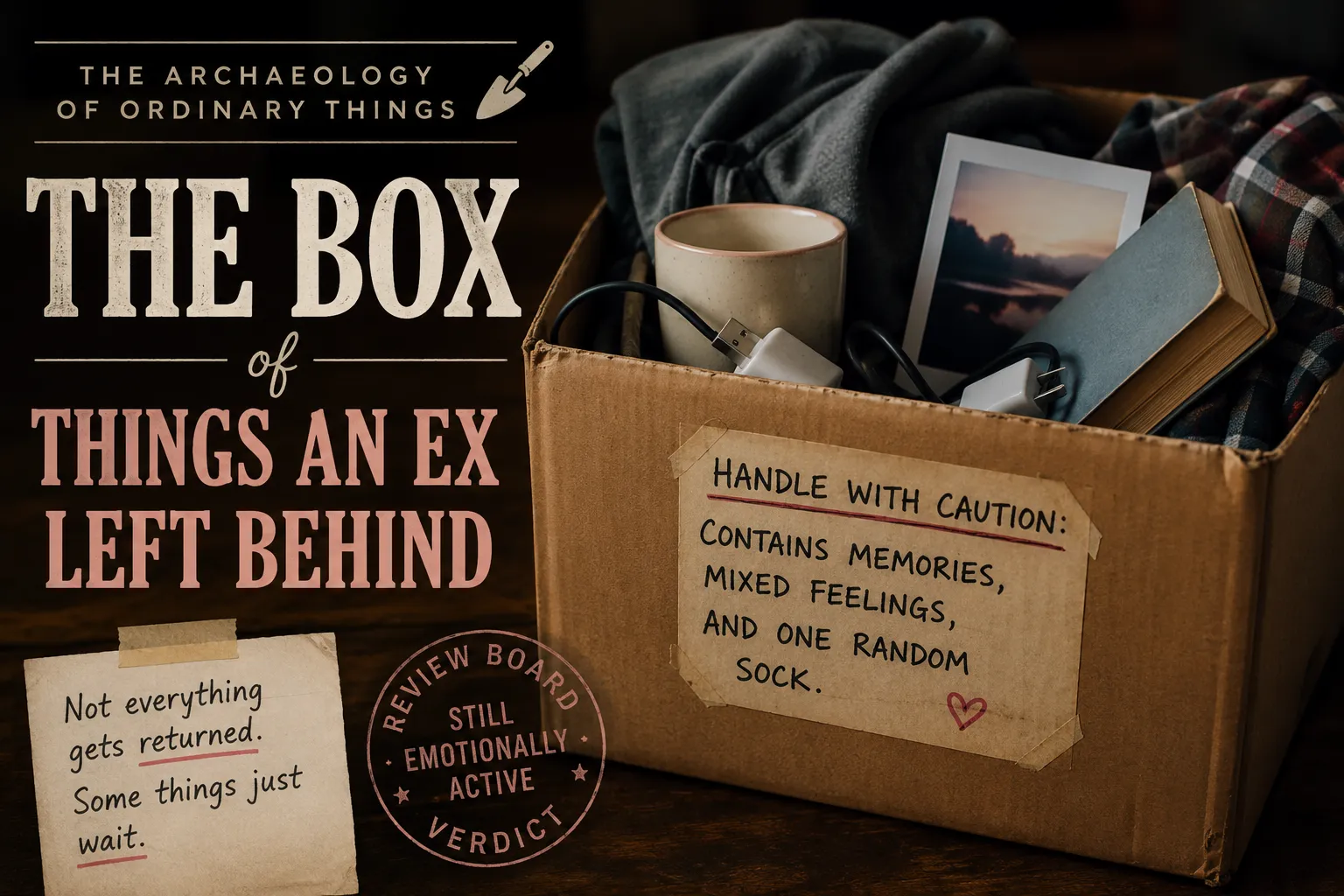
The relationship has ended, but a charger, two shirts, an unfamiliar mug, and one emotionally complicated toothbrush remain. We excavated the box of things an ex left behind.
The relationship has ended.
The conversations have stopped. The photographs may have been hidden. The contact name has been changed, deleted, or left untouched because altering it somehow feels more dramatic than doing nothing.
The person is gone.
Their phone charger is still beside the bed.
This is how the box begins.
At first, it is not officially a box. It is merely a collection of objects that have not yet received instructions. A shirt remains over the back of a chair. A book sits on a shelf. A toothbrush occupies disputed territory near the sink.
Eventually, someone gathers everything together.
The objects are placed inside a cardboard box, plastic storage bin, reusable shopping bag, or container that once held something much less emotionally complicated.
The relationship has now entered its archival phase.
Artifact: The box of things an ex left behind Common habitat: Closets, garages, spare rooms, car trunks, hallway floors, and locations selected specifically to avoid looking at it Original function: Temporary storage Modern function: Containment of personal property and emotional evidence Current status: Packed, postponed, and somehow taking up more space than its dimensions should allow
Where the Artifact Is Found
The box is usually discovered in a transitional location.
It may sit near the front door because someone intends to arrange a pickup. It may be pushed into a closet because the pickup has not happened. It may remain in the trunk of a car because returning it requires a conversation no one wants to schedule.
Some boxes are carefully organized.
Clothing is folded. Electronics are wrapped. Fragile items are protected. Everything is handled with the polite efficiency of a retail return.
Other boxes are archaeological disasters.
One shoe.
Three tangled charging cables.
A coffee mug.
A paperback book with the corner folded down.
A hoodie that may technically belong to the other person but has been in the current household long enough to qualify for residency.
A single sock whose legal ownership cannot be established.
The contents vary, but the box usually contains objects that entered the relationship casually and became complicated only when someone had to decide what should happen to them.
Original Meaning: Before the Objects Became Evidence
Most items in the box were never intended to become symbols.
The charger was brought over because a phone battery was low.
The sweatshirt was left because the evening became warm.
The toothbrush appeared after staying overnight became common enough to justify basic dental infrastructure.
The mug may have arrived with coffee.
The book may have been lent with complete confidence that it would eventually be returned.
At the time, these objects represented convenience.
They suggested that someone expected to come back.
No ceremony announced their arrival. No official relationship milestone was declared when a spare pair of shoes appeared near the door.
The objects simply accumulated.
This is how many signs of intimacy enter a life: not through grand declarations, but through the gradual reduction of inconvenience.
Someone stops bringing everything with them because they no longer feel like a visitor.
A drawer becomes available.
A shelf is cleared.
A charger stays plugged in.
The relationship quietly begins occupying physical space.
Modern Meaning: Property After Belonging
Once the relationship ends, the objects change classification.
The shirt is no longer just a shirt. It is now their shirt.
The toothbrush becomes an expired permit.
The book becomes a pending obligation.
The spare key becomes a security concern.
Objects that once suggested presence now emphasize absence.
This transformation can happen quickly. An item that appeared completely ordinary on Tuesday can feel almost radioactive by Friday.
Nothing about the object has physically changed.
The meaning around it has collapsed.
The box therefore performs an important task. It gathers the scattered evidence of shared life and places it inside a boundary.
Before the box, the person’s presence is distributed throughout the room.
After the box, the remains are contained.
This does not necessarily make them less emotional.
It merely gives the emotion handles.
The Ritual of Packing
Packing the box can feel strangely ceremonial.
Each object requires a decision.
Return it.
Keep it.
Throw it away.
Donate it.
Set it aside because the correct answer is currently unavailable.
Some items are easy.
A work uniform clearly belongs to the other person. Important documents should be returned. Medication, identification, sentimental family items, and expensive personal property do not require philosophical debate.
Other objects are less cooperative.
Who owns the blanket purchased together?
Does a gift belong in the box simply because looking at it feels uncomfortable?
Is the hoodie being kept because it is emotionally meaningful, or because it is objectively the best hoodie in the household?
Was the coffee maker shared property, or did one person merely use it with confidence?
The packing process becomes a review of ownership, memory, and fairness.
Every object asks the same question in a different form:
What still belongs to whom now that “ours” no longer exists?
Emotional Residue
The box contains more than property.
It stores emotional residue.
A shirt may still carry a familiar scent.
A ticket stub may recall an evening that was once important and is now difficult to classify.
A handwritten note may have been ordinary when it was written but devastating when rediscovered beneath a charging cable.
Some objects produce sadness.
Others produce anger.
A few produce complete confusion.
Why is there a decorative spoon?
Was the spoon always here?
Did the relationship contain a spoon-related event that has been entirely forgotten?
Breakups are rarely remembered in a clean sequence. Objects preserve small fragments that memory may not have chosen to keep.
The box can therefore feel less like storage and more like an accidental timeline.
Here is the sweater from the trip.
Here is the game played together.
Here is the cup used every morning.
Here is an item purchased for a future that did not happen.
The emotional weight of the box does not come from the objects’ market value.
It comes from the lives they were present for.
The Return Negotiation
Eventually, the box creates a logistical problem.
It must be returned, collected, mailed, transferred through a mutual friend, or abandoned until enough time has passed that everyone quietly accepts the new ownership arrangement.
This process can be simple.
“Your things are packed. When can you pick them up?”
It can also become the final administrative department of the relationship.
Scheduling a pickup requires contact. Contact may reopen conversation. Conversation may create hope, irritation, nostalgia, defensiveness, or a completely unnecessary argument about a missing kitchen utensil.
The box is particularly dangerous when one person uses it as an excuse to remain connected.
A single object may be returned at a time.
Messages continue.
New items are mysteriously discovered.
The transfer becomes a slow-moving diplomatic exchange conducted through sweaters and household electronics.
Sometimes this delay is practical.
Sometimes the box is not waiting for a pickup.
It is waiting for someone to admit they are not ready for the last reason to speak to disappear.
Misuse and Misinterpretation
The box is often treated as proof of emotional intention.
A carefully packed box may be interpreted as cold.
A disorganized box may be interpreted as disrespectful.
A delayed return may be interpreted as longing.
An immediate return may be interpreted as rejection.
Keeping an object may appear sentimental.
Returning everything may appear final.
The problem is that logistical behavior does not always reveal emotional truth.
Someone may pack carefully because they still care.
Someone else may pack carefully because organization prevents them from falling apart.
A person may delay the return because they want contact.
They may also delay because work is busy, transportation is difficult, or the box has been sitting in a closet so long that it has become part of the architecture.
Not every charger contains a secret message.
Sometimes it is simply difficult to coordinate the exchange of property with a person you no longer know how to speak to.
The box becomes most harmful when it is used as leverage.
Threatening to destroy belongings, refusing to return necessary items, arranging repeated contact, or using valuable property to force a meeting turns an awkward artifact into a control mechanism.
At that point, the box is no longer preserving emotional residue.
It is being weaponized.
The Items Nobody Wants Back
Every box contains at least one object that raises a difficult question:
Does the other person actually want this?
The answer is frequently no.
Not every forgotten item deserves a formal recovery operation.
A half-used bottle of shampoo may not require certified delivery. A worn-out pair of socks may not justify reopening communication. A grocery-store umbrella may have emotionally completed its assignment.
Yet throwing something away can feel strangely disrespectful.
The item belonged to a person who once mattered. Discarding it may feel like making a statement, even when the statement is merely, “This plastic cup cannot remain in my kitchen forever.”
This is where the box becomes less about ownership and more about permission.
Permission to decide that some objects are no longer important.
Permission to stop preserving every trace.
Permission to accept that not all remains require a museum.
The Box That Is Never Collected
Some boxes wait for a pickup that never happens.
Weeks pass.
Then months.
The person may forget. They may not care. They may decide that retrieving the items would cost more emotionally than replacing them.
The box gradually changes ownership through abandonment.
At first, it is their box.
Later, it becomes that box.
Eventually, it becomes something stored behind the holiday decorations.
This is an unusual stage in the artifact’s life. The emotional urgency fades, but the container remains.
Opening it later can feel like discovering evidence from a previous version of yourself.
The objects may no longer hurt.
They may seem smaller than remembered.
A shirt that once felt emotionally impossible may now appear to be an ordinary shirt with a stain near the sleeve.
Time is an aggressive curator.
It removes significance without asking permission.
What the Box Reveals About Humans
The box reveals that relationships occupy physical territory.
Love is often discussed as though it exists only in feelings, promises, and conversations.
In practice, it also exists in drawer space.
It exists in bathroom cabinets, bookshelves, streaming accounts, spare keys, coffee preferences, furniture placement, and the quiet assumption that someone will return tomorrow.
When a relationship ends, the emotional separation may be accompanied by a material one.
The shared environment must be divided back into individual lives.
This is not always dramatic.
Sometimes it is a slow process of noticing.
Their shampoo is still in the shower.
Their favorite snack is still in the pantry.
Their side of the closet is empty, but one hanger remains.
The box exists because humans leave traces wherever they feel they belong.
Removing those traces is not the same as removing the relationship.
But it does make the absence visible.
The Question of What to Keep
Not everything connected to an ex must be destroyed, returned, or hidden.
Some objects may still be useful.
Some memories may eventually become neutral.
A gift does not necessarily stop belonging to the recipient because the relationship ended. A photograph does not become dishonest because the future changed. An item can remain part of a life without remaining part of an active attachment.
The difficult part is determining whether an object is being kept as history or as a doorway.
History says:
This happened.
A doorway says:
This might begin again.
The object itself cannot explain which one it has become.
That meaning belongs to the person holding it.
Final Excavation Note
The box of things an ex left behind is not merely a collection of forgotten property.
It is the physical evidence of a person becoming part of a life and then no longer occupying it in the same way.
The objects inside were once signs of return.
A charger stayed because they would need it again.
A toothbrush stayed because another morning was expected.
Clothing stayed because leaving something behind did not feel risky.
After the relationship ends, those same objects become evidence of a future that stopped arriving.
Eventually, the box must lose its power.
It gets returned, donated, discarded, unpacked, or forgotten.
The objects become ordinary again.
Perhaps that is the final stage of the excavation—not when the box leaves the house, but when its contents stop feeling like remains.
Excavation status: Packed, emotionally active, awaiting final disposition Review Board verdict: No longer useful as a relationship, still inconveniently present as property Handling instructions: Return valuable belongings promptly. Do not use one forgotten sock to extend an expired conversation.