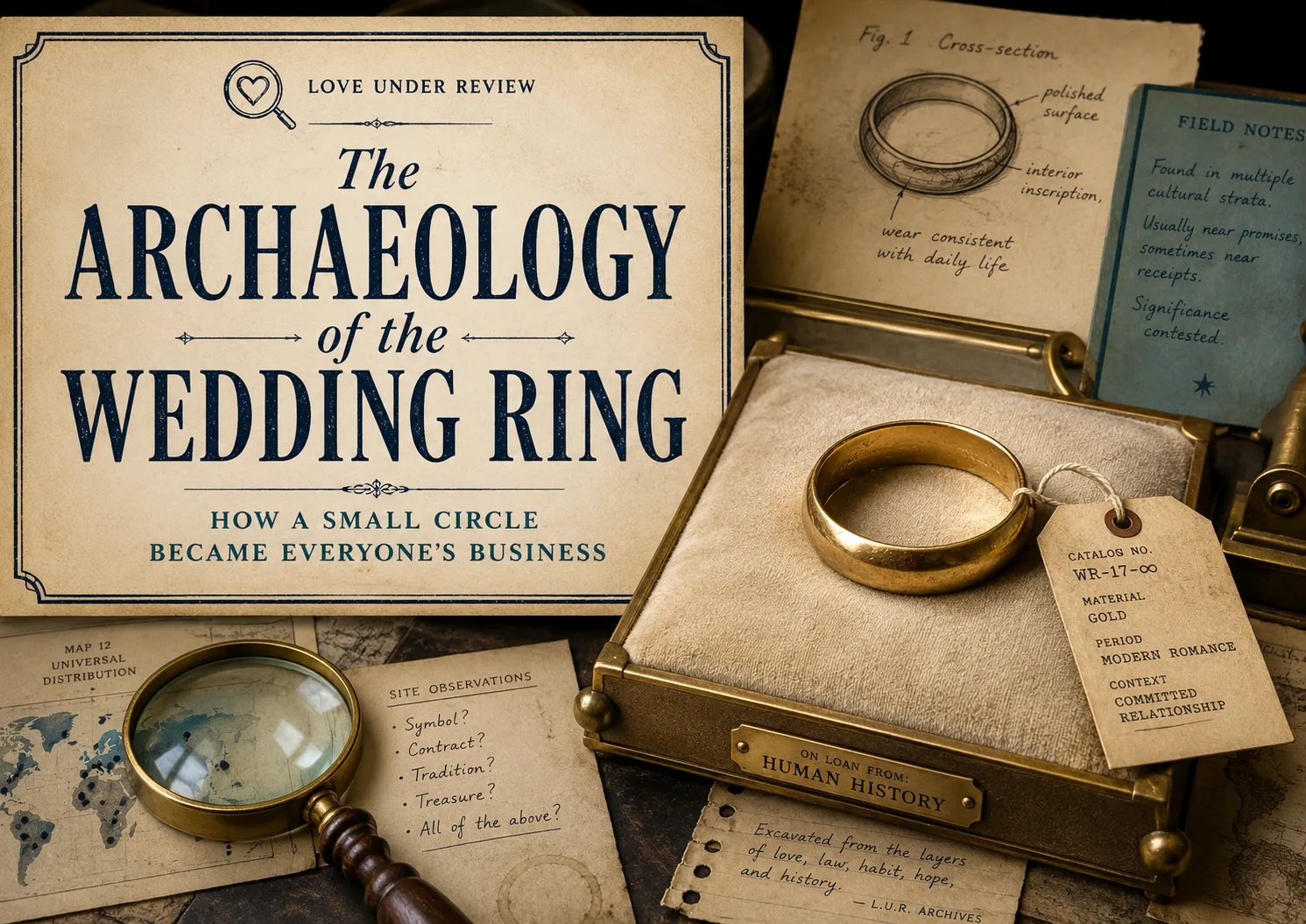
A wedding ring is a tiny circle expected to carry love, loyalty, status, memory, and the occasional panic of being temporarily misplaced. This excavation follows the artifact from ancient ceremony to its modern role as wearable evidence that a private promise exists.
Remove the romance, and a wedding ring is a very small loop of metal with a suspiciously large job description.
It is expected to represent love, loyalty, permanence, exclusivity, legal status, personal history, financial judgment, and the answer to questions strangers have not technically asked.
One glance at the correct finger can apparently tell the public that someone has made a serious promise. One glance at the same finger without a ring can produce speculation, concern, flirtation, or an unnecessary investigation.
For an object that rarely says anything, the wedding ring communicates aggressively.
Artifact: The wedding ring Common habitat: A ring finger, jewelry box, nightstand, bathroom counter, family heirloom case, or one extremely stressful location that the owner cannot currently remember Primary function: Making an invisible relationship visible Current status: Still active and carrying more emotional responsibility than most objects its size
Where the Artifact Is Found
Wedding rings appear in ceremonies, photographs, family stories, jewelry stores, legal marriages, religious traditions, courthouse weddings, elaborate celebrations, and quiet promises made without much spectacle.
They may be worn on the left hand or the right. They may be simple bands, engraved heirlooms, matching sets, inexpensive placeholders, custom designs, or objects valuable mainly because of what happened when they were exchanged.
Some remain on the same hand for decades. Others are removed for work, safety, comfort, separation, divorce, grief, or reasons that become the subject of an entirely different investigation.
The artifact is therefore not limited to one habitat. It travels through the entire life of a relationship.
Original Meaning: Before the Ring Became Romantic Evidence
Rings existed long before the modern wedding industry assigned them coordinated boxes, professional photography, and opinions about acceptable spending.
Across history, rings have been used for decoration, identity, authority, seals, status, religious meaning, remembrance, and personal bonds. Marriage was not the ring’s only assignment.
The clearest evidence for a recognizable betrothal or wedding-band tradition appears in the Roman world. By the third century, rings were firmly established enough as marriage objects that surviving examples can be identified as wedding or betrothal bands.
One Roman gold wedding ring preserved by the British Museum carries the names Valerianus and Paterna. Nearly two thousand years later, two names still sit together on one small object.
That may be the wedding ring’s oldest talent: giving something temporary a chance to outlive the people involved.
Roman and later European rings also used the fede design—two clasped hands representing an agreement, union, or joining. The image is wonderfully direct. Before humans placed a miniature heart on everything, they apparently settled for two hands visibly agreeing to the arrangement.
The ring was not necessarily a private romantic declaration in the modern sense. Marriage could involve family, law, property, religion, inheritance, alliance, and social recognition. The ring existed inside that larger system.
It marked more than affection. It marked a change in status.
Modern Meaning: A Public Symbol for a Private Relationship
The modern wedding ring still marks status, but it now carries a more personal emotional story.
It says:
I chose someone.
Someone chose me.
A promise was made.
This relationship is recognized.
It may also say:
Please stop asking when I am getting married. We have completed that portion of the questioning.
Unlike a marriage certificate, the ring travels openly with the person. It turns a legal, emotional, religious, or personal bond into something visible during ordinary life.
That visibility is part of its power.
A relationship cannot usually be seen while someone buys groceries, answers an email, or waits in line for coffee. The ring gives the relationship a physical representative. It quietly accompanies the wearer into places where the other person is absent.
The promise gets a portable spokesperson.
Ritual Use: How Metal Becomes Evidence
Before a ceremony, a wedding ring is an object.
It has a material, price, size, design, receipt, and return policy.
During the ceremony, it becomes evidence.
The ring is presented, exchanged, placed on a hand, photographed, admired, and connected to spoken vows. From that moment forward, scratches are no longer necessarily damage. They can become history.
The transformation is almost entirely symbolic. The metal itself has not changed. Nothing inside the ring suddenly activates.
Humans changed its meaning by witnessing a ritual together.
This is one of our species’ most reliable abilities. We take an ordinary object, place it inside a ceremony, say important words near it, and permanently alter what it can mean.
Afterward, losing the object can feel like losing part of the promise—even when the promise itself remains completely intact.
Emotional Residue
Wedding rings collect more than fingerprints.
They gather anniversaries, arguments, reconciliations, ordinary mornings, hospital visits, family photographs, private jokes, changing hands, aging skin, and years of being absent-mindedly turned around a finger.
They can represent security and belonging.
They can also represent pressure.
For someone hoping to marry, the ring may symbolize a future that feels close, distant, delayed, or uncertain. For someone who does not want marriage, it may represent a social expectation they never agreed to carry. For someone leaving a marriage, removing it can feel freeing, devastating, strange, or all three before lunch.
A ring can remain emotionally active even after it stops being worn.
It may sit in a drawer after a divorce. It may hang from a chain after a spouse dies. It may be passed to a child, redesigned, returned, sold, buried, misplaced, or kept for reasons the owner cannot easily explain.
The artifact remembers whatever meaning we leave inside it.
Misuse and Misinterpretation
The wedding ring’s largest design flaw is that humans sometimes confuse the symbol with the condition it represents.
A ring can confirm that a ceremony occurred. It cannot confirm that a relationship is healthy.
It cannot measure affection, honesty, compatibility, emotional safety, communication, or whether two people still enjoy being in the same room.
A large ring does not prove a large love.
A modest ring does not prove a modest commitment.
Wearing one does not make someone loyal. Removing one does not automatically make someone dishonest. Forgetting one on the bathroom counter does not necessarily indicate the collapse of civilization, although the first thirty seconds after noticing it may suggest otherwise.
The artifact also attracts public interpretation.
People may notice its size, style, cost, absence, age, or placement and construct an entire relationship report without interviewing either person involved.
The wedding ring began as a symbol of union and somehow became a tiny wearable comment section.
What the Wedding Ring Reveals About Humans
The wedding ring reveals that people are uncomfortable leaving important promises invisible.
Love cannot be placed on a table.
Commitment does not make a sound when someone enters a room.
Shared history has no standard shape.
So humans selected a small, durable object and asked it to stand in for all three.
The circular form now invites familiar ideas about continuity and endurance, but the deeper appeal may be even simpler: a ring remains present.
It is there during the dramatic moments, but it is also there while folding laundry, driving to work, washing dishes, paying bills, and discussing what to eat for dinner.
It places a ceremonial promise inside ordinary life.
Perhaps that is why the wedding ring survives despite changing customs, changing designs, changing marriages, and changing ideas about what commitment should look like.
The object is small enough to wear every day but meaningful enough to contain an entire story.
Final Excavation Note
The wedding ring is neither magical nor meaningless.
It cannot create love, repair a relationship, guarantee loyalty, or prove that two people understand one another. It is not the commitment itself.
But objects do not need magical power to matter.
Sometimes they matter because people agree to remember through them.
A wedding ring is not proof that love exists.
It is proof that humans want love to leave a visible trace.
Excavation status: Still in active use Review Board verdict: Surprisingly useful, emotionally overloaded Handling instructions: Wear according to personal meaning. Do not use as a substitute for communication.