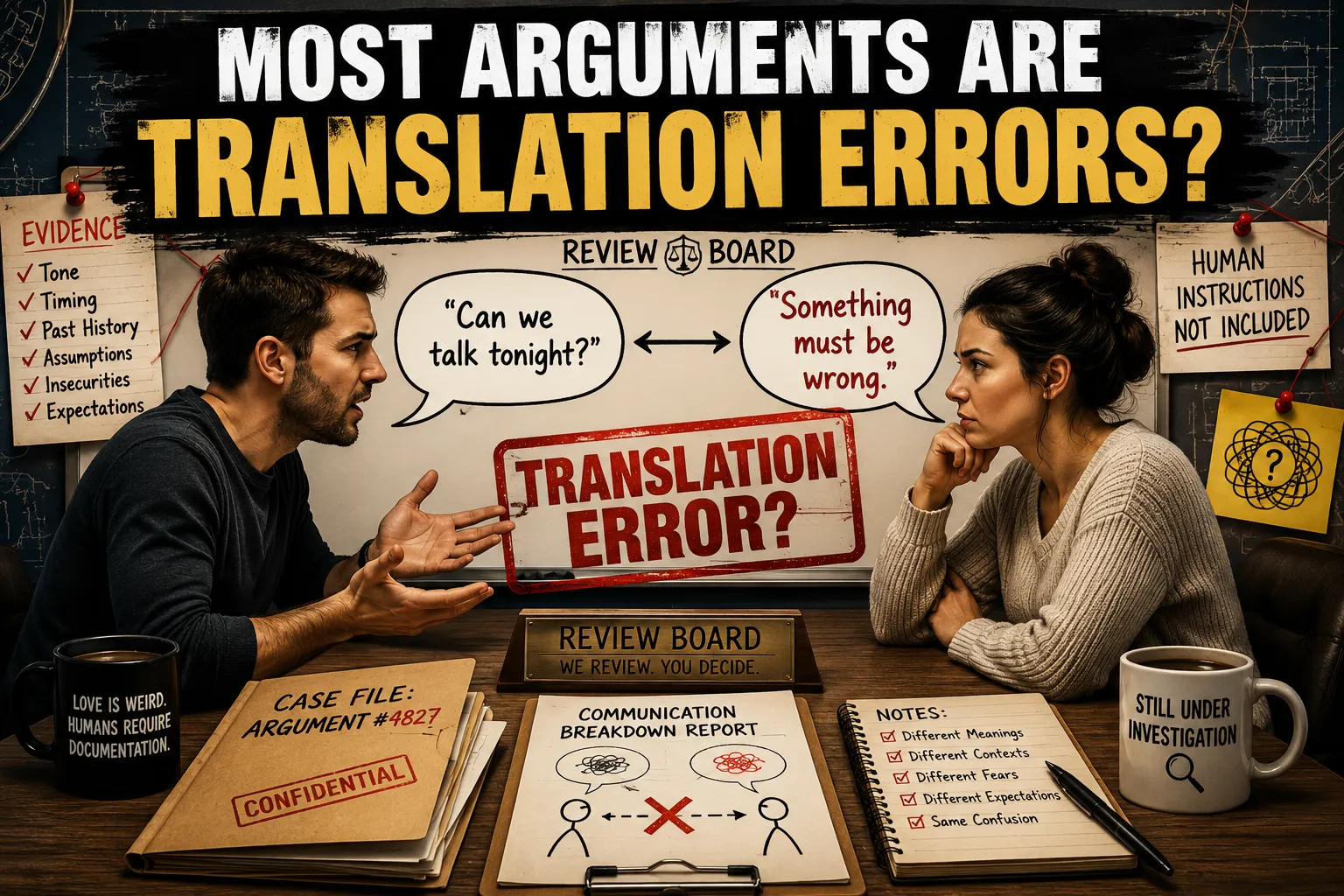
Many relationship arguments may not begin with genuine disagreement. They begin when two people assign different meanings to the same words, tone, silence, or request—and then defend themselves against messages the other person never intended to send.
Two people can speak the same language, hear the same sentence, and somehow leave the conversation believing they attended entirely different arguments.
One person thinks they asked a simple question.
The other person hears an accusation, a warning, and the opening statement of a trial they did not know had been scheduled.
This brings us to today’s unproven theory:
Theory Statement
Many relationship arguments are not disagreements about the same issue.
They are translation errors.
The words may be understandable. The sentences may be grammatically correct. But somewhere between intention and interpretation, the message becomes something else.
“I wish we spent more time together” becomes “You are failing me.”
“Can we talk about what happened?” becomes “Prepare your defense.”
“I need some space” becomes “I no longer care about you.”
By the time either person responds, they may no longer be discussing what was actually said. They are responding to what they believe the sentence revealed.
The original message has left the building.
Why This Theory Might Be True
Human communication rarely consists of words alone.
Every sentence arrives carrying tone, timing, facial expression, previous arguments, old insecurities, unmet expectations, and whatever happened earlier that day.
A sentence can therefore have at least three meanings:
- What the speaker said
- What the speaker intended
- What the listener believed it meant
Occasionally, all three agree.
This is considered a minor communications miracle.
More often, the listener interprets the message using information the speaker may not even know is present.
A delayed response might mean someone was busy.
It might also feel like dismissal to a person who has repeatedly been ignored.
A request for reassurance might be intended as vulnerability.
It might sound like distrust to someone who believes they have already proven themselves.
Neither person necessarily has to be dishonest for the conversation to go wrong. They only need to use different emotional dictionaries.
Evidence Observed
The first suspicious piece of evidence is how often arguments become larger than the event that supposedly caused them.
A forgotten text becomes a debate about effort.
A changed plan becomes a debate about reliability.
A poorly timed joke becomes a debate about respect.
The immediate event may be real, but it appears to activate a larger meaning.
The argument is no longer about the text, plan, or joke. It is about what the event allegedly proves.
Another clue is the frequency with which people respond to accusations that were never directly made.
Someone says, “I felt left out.”
The response is, “So now I’m a terrible person?”
That conclusion did not appear in the original sentence. It was added during translation.
The speaker may then respond to the defensiveness rather than the original problem. The listener responds to that response. Within minutes, both people are fighting over a conversation neither of them intended to have.
The Review Board recognizes this as conversational mission drift.
Common Translation Failures
Original message: “I would like more communication.”
Possible translation: “Nothing you do is enough.”
Original message: “I need a little time to think.”
Possible translation: “I am preparing to leave.”
Original message: “That bothered me.”
Possible translation: “You are a bad partner, friend, or human specimen.”
Original message: “You seem quiet.”
Possible translation: “Explain yourself immediately.”
Sometimes the mistranslation is caused by fear. Sometimes it is caused by history. Sometimes the speaker chose terrible wording and then acted surprised when the sentence caught fire.
The theory does not place every error on the listener.
Speakers also package messages badly.
People soften important statements until they become invisible. They replace specific concerns with dramatic generalizations. They insist that nothing is wrong while communicating, through every available nonverbal channel, that something is extremely wrong.
Humans then expect other humans to locate the correct meaning without access to the original instruction manual.
The Argument Beneath the Argument
Many conflicts appear to contain a second, quieter conversation underneath the spoken one.
The surface argument might be:
“You did not tell me the plans changed.”
The underlying questions might be:
“Can I depend on you?”
“Do my feelings matter?”
“Am I included in your decisions?”
“Are we interpreting this relationship the same way?”
People do not always ask those questions directly. Direct questions create the possibility of direct answers, and direct answers are occasionally terrifying.
Instead, the questions emerge disguised as irritation, sarcasm, silence, or an extremely detailed argument about whose responsibility it was to buy milk.
The milk may be innocent.
The milk has simply been called as a witness.
The Strongest Counterargument
Some arguments are not translation errors.
Sometimes people understand one another perfectly and genuinely disagree.
They may have incompatible values, expectations, priorities, boundaries, or definitions of commitment. One person may be communicating clearly while the other repeatedly dismisses what is being said.
There are also situations involving deliberate dishonesty, manipulation, cruelty, or refusal to take responsibility. Calling those problems “miscommunication” can minimize behavior that was understood perfectly well.
Better translation cannot resolve every conflict.
It cannot transform incompatible goals into compatible ones. It cannot make someone care. It cannot turn repeated disrespect into an innocent vocabulary problem.
Sometimes the message arrived correctly.
The recipient simply did not like it.
Personal Bias Disclosure
This theory is biased toward assuming that many people enter ordinary disagreements in imperfect but relatively good faith.
It also gives communication significant power because communication is visible and reviewable. The private motives behind someone’s behavior are much harder to examine.
That means this theory may overestimate confusion and underestimate avoidance, selfishness, or genuine incompatibility.
The Review Board acknowledges the limitation.
Reluctantly.
Review Confidence Rating
7 out of 10
There is enough ordinary human evidence to consider the theory plausible.
People frequently react to implied meanings, defend themselves against unstated accusations, and discover halfway through an argument that they were discussing different concerns.
However, the theory cannot explain every conflict without becoming an excuse.
“Translation error” should describe misunderstanding—not erase responsibility.
Final Theory Status
Plausible, but incomplete.
A surprising number of arguments may begin when intention and interpretation stop matching. The same sentence can represent concern to one person, criticism to another, and a declaration of war to someone who has not eaten since breakfast.
But not every disagreement needs a translator.
Some need honesty. Some need accountability. Some reveal a real incompatibility that clearer language cannot remove.
For now, the theory remains active:
Many arguments are not two people disagreeing about one thing.
They are two people defending themselves in separate conversations that happen to be occurring in the same room.
Final Review Board Status: Still under investigation, with strong evidence of emotional subtitle failure.