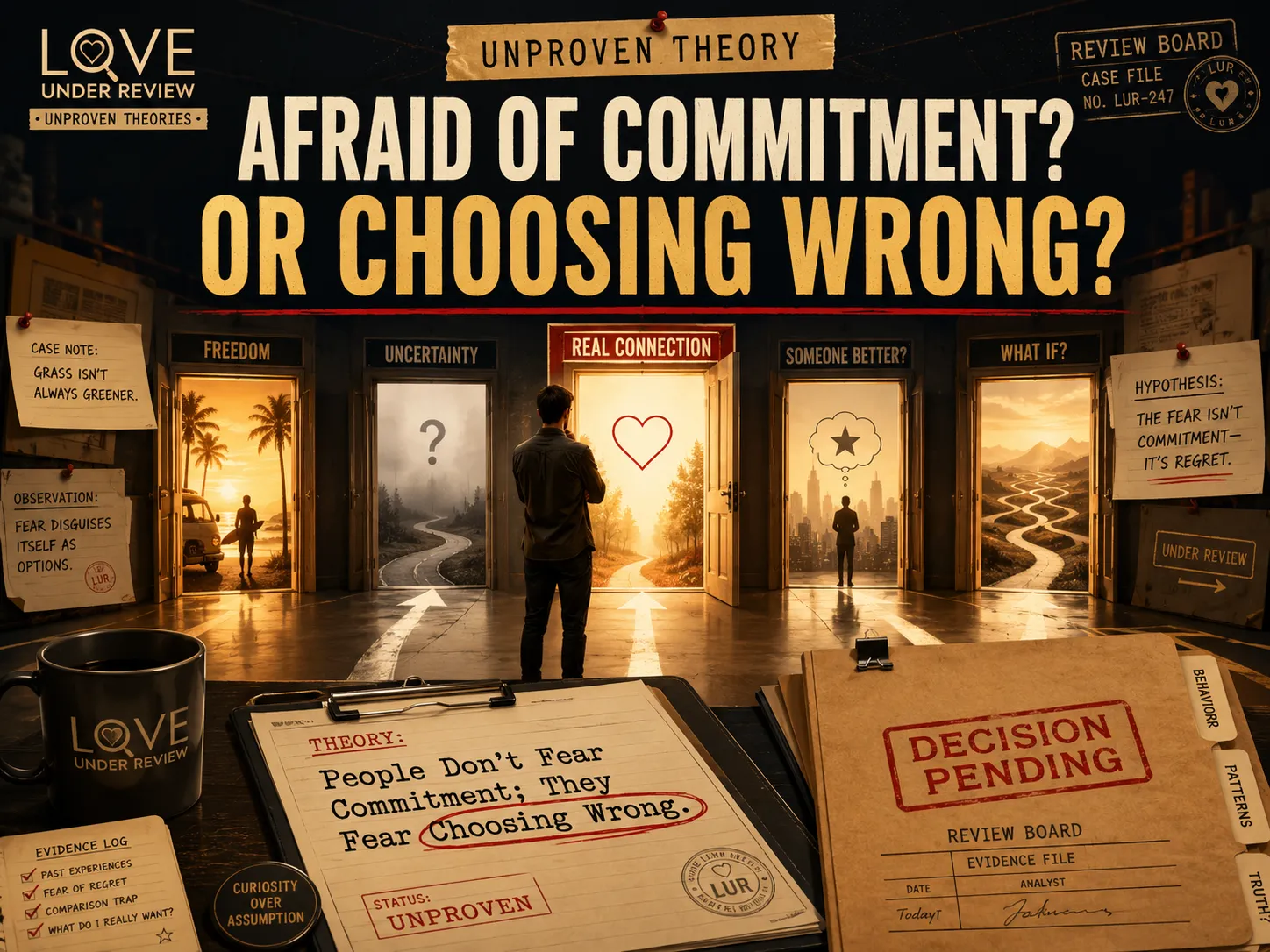
Some people may not be afraid of commitment itself. They may be afraid of committing to the wrong person, missing a better possibility, repeating an old mistake, or discovering too late that certainty never arrived.
Commitment has developed an unfortunate reputation.
It is often treated like a locked door, a courtroom sentence, or a mysterious condition that causes otherwise functional adults to disappear after someone asks, “So, what are we?”
But perhaps commitment itself is not always the terrifying part.
Perhaps the real fear is choosing.
More specifically, choosing one person while knowing that the decision may eventually prove to be wrong.
This brings us to today’s unproven theory:
Theory Statement
Many people who appear afraid of commitment are not actually afraid of closeness, loyalty, or long-term relationships.
They are afraid of choosing the wrong person.
They may want love. They may want stability. They may even want the future they keep insisting they are “not ready” for.
What they do not want is to invest years, build a life, become emotionally dependent, and later discover that they selected the wrong human from an application pool containing several billion candidates.
Commitment asks people to move forward without complete information.
Humans generally dislike incomplete information unless they are using it to form an immediate opinion about a stranger online.
Why This Theory Might Be True
Commitment requires a person to accept uncertainty while behaving as though the decision deserves confidence.
That is a difficult combination.
No relationship arrives with a verified outcome, a satisfaction guarantee, or a customer-support number for when someone begins loading the dishwasher incorrectly.
A person can pay attention, communicate clearly, take their time, ask meaningful questions, and still make a choice that does not work.
That possibility can make commitment feel less like romance and more like signing a contract whose final pages remain hidden.
People may therefore delay choosing because delay preserves possibilities.
As long as no final decision has been made, no path has been fully lost.
The almost-relationship can remain promising.
The dating profile can remain active.
The imagined better match can remain somewhere beyond the next swipe.
Potential is difficult to disappoint because potential has not yet been required to live in the real world.
Evidence Observed
One piece of evidence is how often people say they want a relationship while avoiding every moment that would turn a connection into one.
They enjoy closeness.
They want regular communication.
They expect loyalty.
They may become jealous, protective, or emotionally invested.
But when the relationship requires a name, boundary, or direction, the emergency exits suddenly become very interesting.
This behavior is often classified as fear of commitment.
That may be accurate.
But it may also be fear of making the wrong commitment.
The person is not necessarily rejecting the idea of partnership. They may be rejecting the risk of selecting this particular partnership before they feel completely certain.
Unfortunately, complete certainty is not a standard feature of human relationships.
It remains unavailable in the current version.
Another clue appears when someone becomes more interested after the relationship is no longer available.
Distance removes the pressure to choose.
Once the other person moves on, the relationship can return to its safest form: possibility.
There is no longer an immediate decision to make. The person can miss what might have been without having to manage what it actually was.
The unavailable relationship becomes emotionally convenient because it can be idealized without being tested.
The Fear Behind the Fear
Choosing wrong can mean many different things.
It might mean repeating a painful relationship pattern.
It might mean disappointing family or friends.
It might mean losing independence.
It might mean realizing that attraction was mistaken for compatibility.
It might mean staying too long because leaving would make the original decision feel like a failure.
It might mean watching other people appear happier and wondering whether a better option was available.
This fear can become especially strong for people who believe there is one correct person and every other choice represents a permanent mistake.
Under that belief system, dating stops being the process of learning whether two imperfect people can build something together.
It becomes an exam with one correct answer and several emotionally expensive wrong ones.
No pressure.
The Problem of Too Many Possibilities
Modern dating often presents choice as freedom.
More profiles, more introductions, more access, more possibilities.
In theory, this should make choosing easier.
In practice, abundance may increase suspicion.
When another possibility is always visible, an ordinary relationship can begin competing with imaginary people who have not yet had the opportunity to reveal any annoying habits.
A real person eventually becomes tired, distracted, uncertain, inconsistent, or bad at selecting restaurants.
An imagined alternative remains perfectly compatible because they have not said anything yet.
The comparison is unfair, but the imaginary candidate performs remarkably well.
This can make ordinary doubts feel like evidence that the relationship is wrong.
Instead of asking, “Can we work through this?”
A person may ask, “Would this problem exist with someone better?”
The answer is unknowable, which allows the question to remain permanently persuasive.
Commitment as a Loss
Choosing one path does not only create a future.
It also closes other possible futures.
That is part of what makes commitment meaningful, but it may also be what makes it frightening.
To choose one person is to stop actively choosing everyone else.
It means accepting that some imagined stories will never be tested.
People often celebrate what commitment adds: security, partnership, familiarity, shared plans, and someone who knows how they take their coffee.
They discuss less often what commitment asks them to surrender: alternative futures, open possibilities, and the fantasy that the perfect decision is still waiting somewhere ahead.
For someone who fears regret, this can feel less like choosing love and more like choosing which possibilities to lose.
The Strongest Counterargument
Some people genuinely do fear commitment.
They may avoid emotional dependence, resist vulnerability, dislike responsibility, or prefer relationships that remain casual and undefined.
Others may not want a long-term partnership at all.
That is not necessarily fear. It may simply be preference.
There are also people who use uncertainty as a convenient excuse.
They may enjoy receiving closeness, attention, affection, and loyalty without accepting the responsibilities that normally accompany them.
Calling that behavior “fear of choosing wrong” could make it sound more thoughtful than it really is.
Sometimes a person is not trapped in a deep philosophical crisis about alternate futures.
Sometimes they simply do not want the relationship enough.
The theory must also avoid turning rejection into hidden desire.
Someone who says they do not want to commit may be accurately describing their feelings. Their reluctance does not automatically mean they secretly want the relationship but are frightened by its importance.
“No” should not be translated into “convince me.”
The Review Board has reviewed this practice and found it exhausting.
Personal Bias Disclosure
This theory is biased toward believing that hesitation often has an underlying logic.
It assumes people sometimes avoid decisions not because they are careless, but because they understand how much those decisions can change.
It may therefore give indecision too much credit.
Fear can explain behavior without excusing it.
A person may genuinely fear choosing wrong and still cause harm by keeping someone in uncertainty while they preserve every available option.
An understandable reason does not automatically create acceptable behavior.
The Review Board would like that entered into the record.
Review Confidence Rating
7.5 out of 10
The theory appears plausible because many people seek the benefits of commitment while resisting the decision that formally creates it.
Fear of regret, lost alternatives, repeated mistakes, and imperfect certainty may explain part of that contradiction.
However, the theory cannot account for everyone.
Some people fear vulnerability itself. Some do not want commitment. Some are not sufficiently interested in the person asking for it. Others may simply prefer having options without accepting responsibility for what that uncertainty does to someone else.
Human motives remain inconveniently varied.
Final Theory Status
Strongly plausible, with significant exceptions.
Many people may not fear commitment as an abstract idea.
They may fear committing before they can guarantee that the choice will remain correct.
The problem is that relationships rarely provide that guarantee in advance.
Eventually, choosing requires a person to accept that certainty may follow the decision rather than precede it.
Or it may never arrive completely.
That does not mean people should ignore doubts, rush into relationships, or treat incompatibility as ordinary anxiety.
It means that waiting for a choice to become completely risk-free may be another way of avoiding choice altogether.
For now, the theory remains active:
Some people are not running from commitment.
They are standing in front of several imaginary doors, afraid that opening one will reveal that the best life was behind another.
Final Review Board Status: Strong evidence, but the exits remain unlocked.