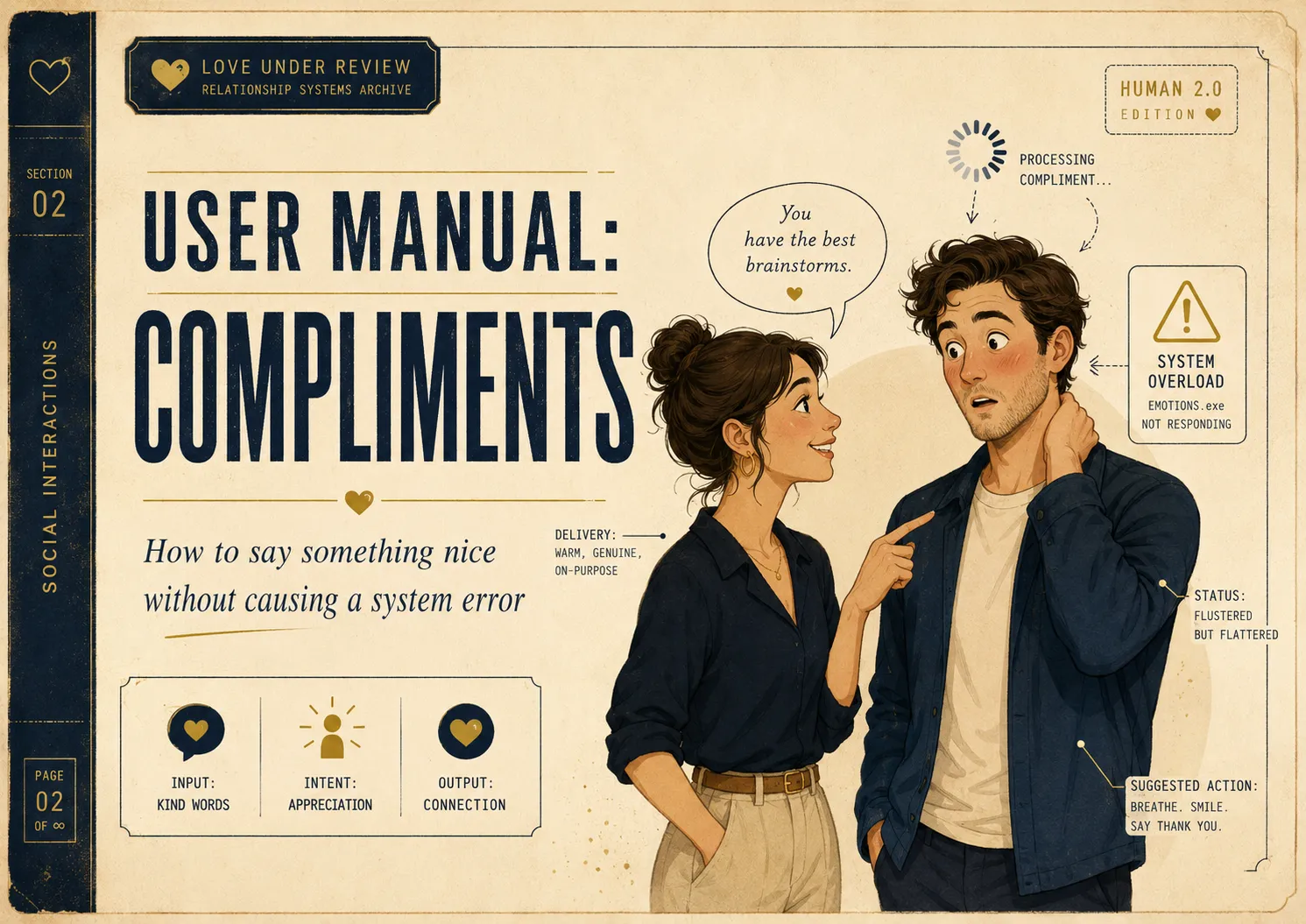
Compliments were designed to make humans feel appreciated. Unfortunately, they can also cause denial, nervous laughter, accidental flirting, and detailed explanations of where a shirt was purchased. This manual explains proper operation.
Compliments appear to be one of the simplest tools available in human communication. One person notices something positive. That person says it out loud. The other person feels good.
That is how the feature was apparently designed.
In actual use, compliments can cause immediate eye-contact failure, suspicious analysis, involuntary self-criticism, accidental flirting, and a detailed explanation of why the compliment is technically incorrect.
This manual covers the safe operation of compliments, including how to give one, how to receive one, and how to avoid turning a kind sentence into a social emergency.
Feature Description
A compliment is a short positive observation delivered from one human to another.
Compliments may recognize:
- Appearance
- Effort
- Skill
- Character
- Taste
- Progress
- Kindness
- Something specific the person said or did
The feature works best when the observation is sincere, clear, and given without an immediate request attached.
A compliment is not supposed to be an invoice.
“You did an amazing job on that presentation” is a compliment.
“You did an amazing job on that presentation, so could you also finish mine?” is a transaction wearing a compliment as a disguise.
Intended Function
The compliment system was developed to help humans communicate appreciation without requiring a formal ceremony, handwritten declaration, or annual performance review.
When operating correctly, a compliment can:
- Make someone feel noticed
- Reinforce positive behavior
- Create warmth in a conversation
- Reduce social distance
- Express affection or admiration
- Improve a difficult day by approximately 12%
- Remain in the recipient’s memory for several years without warning
Compliments are especially effective when they identify something the recipient chose, created, practiced, or worked hard to accomplish.
“You have a great smile” may be appreciated.
“You make people feel included when you talk to them” may be remembered.
Both can work. One simply reaches a different part of the operating system.
Setup Requirements
Before delivering a compliment, confirm that the following conditions are present:
- The compliment is true. Humans can sometimes detect manufactured praise, especially when it sounds like it was copied from a customer-service script.
- The compliment is specific enough to feel real. “You’re amazing” is pleasant but broad. “You explained that in a way that finally made sense to me” gives the recipient evidence.
- The compliment does not demand a particular response. The recipient is not required to blush, flirt, provide a compliment in return, or begin planning a future together.
- The setting is appropriate. Some compliments feel different in private, at work, on a first date, in a public comment, or when shouted from a moving vehicle.
- The compliment is about the recipient. “You look much better than you usually do” contains a compliment, but it has been damaged during shipping.
Standard Operating Procedure: Giving a Compliment
For basic operation, use the following sequence:
Step 1: Notice something genuinely positive.
Step 2: State the observation clearly.
Step 3: Stop talking before you accidentally modify it.
Examples:
- “That color looks great on you.”
- “You handled that situation really well.”
- “You have a way of making people feel comfortable.”
- “That was a thoughtful thing to do.”
- “I like how excited you get when you talk about that.”
- “You have excellent taste in extremely unnecessary coffee mugs.”
The final step is essential.
Many compliment failures occur because the sender becomes uncomfortable with sincerity and continues adding words until the original message can no longer be recovered.
“You look really nice today.”
Successful transmission. Stop here.
“I mean, you always look nice. Not that I am constantly evaluating how you look. I just noticed today specifically. Not that I do not notice on other days.”
System failure.
Common Malfunctions
Malfunction 1: Compliment Rejection
Input: “You did a great job.”
Common response: “No, I didn’t. I made three mistakes, forgot part of it, and briefly stopped understanding my own name.”
Some humans interpret a compliment as an invitation to present opposing evidence.
This usually happens because accepting praise can feel arrogant, vulnerable, unfamiliar, or suspiciously easy.
Recommended fix: Say “Thank you.”
No supporting documentation is required.
Malfunction 2: Immediate Compliment Return
Input: “I like your jacket.”
Response: “Thanks. I like your shoes.”
Returning a compliment is not prohibited, but it should not feel like settling a debt.
A compliment may be accepted without immediately producing one of equal or greater value.
Compliments are not tennis balls. They do not always need to be hit back.
Malfunction 3: Accidental Insult
Some compliments contain hidden structural damage.
Examples include:
- “You’re actually really smart.”
- “You look good for your age.”
- “I usually don’t like people like you.”
- “That outfit is very flattering.”
- “You clean up well.”
- “You’re brave for wearing that.”
These statements may begin with positive intent but arrive carrying several unanswered questions.
When possible, remove the surprising comparison, unnecessary qualifier, or implied previous disappointment.
Malfunction 4: Compliment or Flirting?
The same compliment may be interpreted differently depending on tone, timing, relationship, eye contact, existing attraction, punctuation, and whether it was followed by an unusual number of emojis.
“You look nice” may mean:
- You look nice.
- I am attracted to you.
- I am being friendly.
- I noticed you made an effort.
- I have forgotten how normal conversation works.
- Please analyze this sentence for the next four business days.
The manual cannot guarantee accurate interpretation.
Malfunction 5: Appearance-Only Mode
Compliments about appearance can be welcome, but repeatedly complimenting only someone’s appearance may suggest that no other features were detected.
For improved performance, occasionally recognize:
- Humor
- Reliability
- Curiosity
- Creativity
- Patience
- Courage
- Thoughtfulness
- Knowledge
- The ability to remember everyone’s coffee order without taking notes
A person may already know what they look like. They may not know that someone notices how hard they try.
Compatibility Issues
Compliments are not processed identically by every human.
Some users accept praise comfortably.
Others may:
- Look away
- Laugh
- Change the subject
- Assume sarcasm
- Deny the compliment
- Suspect an upcoming favor
- Remember the compliment at 2:14 a.m. six years later
This does not necessarily mean the compliment failed.
The recipient’s visible reaction may reflect discomfort with attention rather than dislike of the message.
Compatibility can also be affected by context. A compliment from a friend may feel warm. The same words from a supervisor, stranger, former partner, or person standing far too close in a grocery store may activate different security settings.
Troubleshooting Guide
Problem: The recipient dismisses the compliment
Do not begin an argument to prove that your compliment is correct.
You may say:
“I meant it.”
Then allow the message to remain in the system.
Problem: The recipient seems uncomfortable
Reduce intensity and give them space. Do not demand an explanation for why they failed to receive praise correctly.
Problem: The compliment sounded like flirting
Clarify only when clarification is genuinely needed. Excessive clarification may create additional suspicion.
Problem: You want to compliment someone but cannot find the right words
Use this basic formula:
Specific observation + why it mattered
Example:
“You checked in on everyone during that meeting. It made the whole conversation feel less tense.”
Problem: You received a compliment and your mind has gone blank
Use the approved default response:
“Thank you. I appreciate that.”
This response is compatible with most compliment types and requires minimal processing power.
Known Bugs
The following issues remain unresolved:
- Humans may distrust sincere praise while believing criticism immediately.
- One negative remark can overwrite several positive ones.
- Compliments from a particular person may carry significantly more processing weight.
- Some users remember compliments from strangers longer than compliments from people they know.
- A compliment delivered at the wrong moment may be interpreted as sarcasm.
- Written compliments may be reread until the original tone is no longer detectable.
- The phrase “You look different” continues to produce unpredictable results.
- Some humans become suspicious whenever someone is nice without an obvious reason.
- The system may confuse appreciation, attraction, politeness, admiration, and romantic interest.
No universal patch is currently available.
User Warning
Warning: Compliments may cause blushing, nervous laughter, temporary loss of vocabulary, unexpected emotional impact, or an unnecessary explanation of where the item was purchased and how much it cost.
Do not attach guilt, pressure, manipulation, comparison, or obligation.
A compliment should leave the recipient feeling more appreciated, not more indebted.
Final Manual Note
Compliments work best when they are treated as observations rather than performances.
Notice something good. Say it clearly. Mean it. Then allow the other person to receive it in whatever awkward human way their system permits.
The compliment does not need to be perfect. It only needs to be sincere enough to survive delivery.
Humans may require documentation, but occasionally one honest sentence is enough.